
Table of Contents
Imagine a business that has completed its fire risk assessment and received a report identifying several actions. Months later, some remain outstanding, with no clear record of who is responsible for completing them. The office manager thought facilities had them, facilities assumed the landlord was handling them, and the fire marshal believed the assessor would follow up. If your fire risk assessment has actions, this guide explains who should close them, how to build a fire risk assessment action plan and how to show each one is finished.
Who owns fire risk assessment actions?
In the scenario above, the central problem was a lack of clear accountability. No individual had been assigned responsibility for each action, and there was no agreed process for verifying completion. Closing actions starts with understanding what the report found, then being clear about who holds the legal duty and who does the work.
Understand the findings before assigning work
A suitable and sufficient assessment looks at the fire hazards, the people at risk, the existing fire precautions and any further measures needed for your premises and activities. It is not just a checklist of equipment. For each finding in the fire risk assessment report, set out the deficiency, where it is, who could be affected, why it matters and what improvement is intended.
Findings might concern escape routes, doors or fire detection. If any fire risk assessment recommendations are unclear, or their priority is not obvious, ask the competent fire risk assessor to explain them. A routine assessment can also point to a technical issue, such as a suspected compartmentation problem, that needs a separate specialist investigation before anyone can decide what to do.
The responsible person’s legal duties
In non-domestic premises in England and Wales, the Regulatory Reform (Fire Safety) Order 2005, as amended, requires the responsible person to assess fire risks and put appropriate precautions in place. That person may be an employer, owner, landlord, occupier or anyone else with control of the premises. More than one person can share fire safety responsibilities for the same building, depending on what each one controls. Scotland and Northern Ireland have their own legislation.
Under Article 9 of the Fire Safety Order, the assessment has to identify the general fire precautions needed to protect relevant people. Receiving the report does not end that duty. The government guidance on fire safety responsibilities also covers how duty holders work together and keep measures in place.
What delegation does and does not change
Commissioning an assessor, or handing delivery to a manager or contractor, does not transfer the responsible person’s legal accountability for appropriate fire safety measures. You can delegate tasks, but the duty stays with you. In practice, the assessor identifies deficiencies and recommends measures. An operational owner arranges the work, a competent specialist delivers it and a suitable person checks the result.
These are practical roles, not job titles set out in law. In the opening scenario, the fire marshal was not the right owner for most of the actions. A fire marshal can help with checks, drills and evacuation, but does not automatically own every action arising from the assessment.
Which actions need attention first?
Once each finding is understood, decide the order of work. The order matters because some deficiencies leave people exposed now, while others are improvements that can be planned. Getting this right also shows when a target date is reasonable and when it is not.
Set priorities from the actual risk
Prioritise fire safety remedial actions by the potential consequences, the people exposed, the existing precautions and the urgency the assessor identified. Their order in the FRA report, or how convenient the work is, should not set the priority. The government assessment checklists for England and Wales ask for prioritised actions with timescales and a named person responsible, but they do not set one timetable for high, medium or low findings.
Contractor availability, budget and access all affect when work can be done. On their own, they do not change how serious the fire risk is. If a high-priority action is held up by funding, record the delay and manage the risk in the meantime. Do not quietly downgrade the action.
Control serious concerns while work is open
Where a finding suggests protection may be inadequate, get competent advice promptly. The responsible person should then decide what precautions are needed until the permanent work is finished. This is a judgement about your premises, not a standard response you can copy from somewhere else.
Interim precautions have to fit the particular deficiency and be checked while the action stays open. They do not automatically replace adequate permanent protection, and they should not become the long-term arrangement simply because they seem to be working.
Sometimes people cannot be kept safe enough with interim measures. In that case, restricting or stopping use of the affected area or activity may be necessary. It can be disruptive, but it is a proportionate answer when the alternative is leaving people exposed.
Manage targets and overdue work
A risk-based target date helps with planning. It does not make an unacceptable condition safe while the work is outstanding. When an action becomes overdue, retain the original finding and risk rating for audit purposes, but reassess the current risk where circumstances have changed. Record the reason for the delay, any interim precautions, the revised target date, escalation decisions and the next review date.
Changing a status just because the deadline has passed hides the problem. Keep overdue and carried-over findings visible so they are discussed at the next review, rather than dropping out of sight between reports.
How do you assign every finding?
Going back to our illustrative business, a single shared record would have shown at a glance that nobody owned the open actions. That record is the backbone of fire safety management after an assessment. It turns findings into named tasks with evidence behind them.
Build a fire risk assessment action plan
A live fire risk assessment action plan links each finding to its location, the outcome needed, its priority, a named owner, a risk-based target, resources, dependencies, interim precautions, progress and closure evidence. Each action moves through five practical stages: identified, assigned, implemented, verified and closed.
Use statuses that separate work in progress from work completed but awaiting verification. The table below shows illustrative entries. The timescales are examples only, not universal deadlines.
| Finding | Required action | Owner | Risk-based target (illustrative) | Interim precautions | Completion evidence |
| Stock obstructing a designated escape route | Clear the route and agree where deliveries are stored | Warehouse supervisor | Immediately | Stop storing stock on the route; extra checks during occupied hours | Inspection record and dated photographs; ongoing route checks |
| A fire door that does not close correctly | Competent specialist to assess and carry out appropriate work | Facilities manager | Urgently, with the required response and completion timescale determined by the risk and competent advice. | As advised by competent person for that location | Record of work done and a check of the door’s relevant performance |
| Staff unfamiliar with evacuation arrangements | Revise instructions and brief all staff | HR or operations manager | Within weeks | Briefings for staff on each shift | Revised procedure, training records and exercise record |
Separate ownership from technical delivery
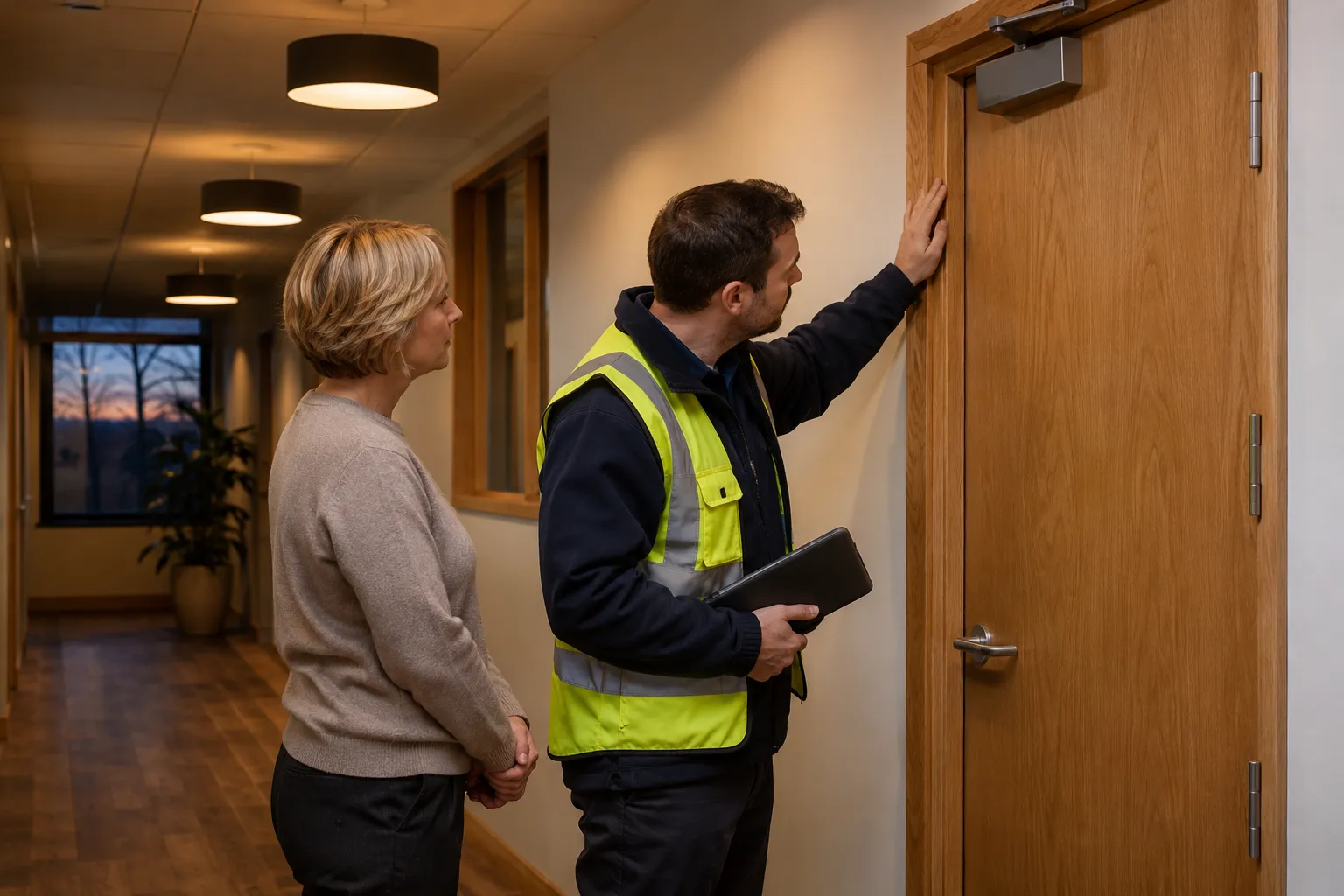
One named owner can coordinate an action even when someone else approves the spending and a competent contractor does the technical work. In the fire door example, the facilities manager owns the action, a director may sign off the cost and a specialist carries out the repair.
The owner tracks dependencies and collects completion evidence. Technical design, repair, installation, inspection or testing needs competence suited to that particular work. Staff should not repair specialist systems themselves.
A spreadsheet can support this process, but an entry marked “done” does not show that a defect has been put right. The record needs reliable evidence and follow-up behind it.
Coordinate action across shared premises
Where several responsible persons share premises, they have to cooperate and coordinate their fire safety arrangements. A lease or contract may allocate tasks between them, but it does not automatically remove statutory duties. For each affected area or system, agree who controls it, who commissions and pays for the work, who arranges access and who receives the findings and completion records.
Exchange relevant information about risks and precautions, and coordinate any arrangements the work affects, such as evacuation routes. If a landlord, tenant or contractor causes a delay, record it and follow it up. An action is not closed because an instruction has been sent. Salusphere Global provides fire risk assessment support, including prioritised action plans, and can answer questions about putting recommendations into practice after the report.
When is an action genuinely closed?
In our illustrative business, confusion over responsibility meant several actions remained outstanding. Even where a contractor had been appointed, the actions could not be considered complete until the necessary work had been carried out and verified.
Compare the result with the finding
Before closing an action, compare the completed work with the original deficiency and the intended fire safety outcome, and check whether any defect or limitation remains. A purchase order, booking, attendance record or invoice shows that work was instructed or billed, not that the problem was solved. Record who verified the work, when, the result and who authorised closure.
Keep evidence suited to the action
Suitable evidence depends on the action. It may include dated photographs, fire safety inspection records, service reports, test results, commissioning information, revised procedures or training records. Match the evidence to what the finding was about:
- Cleared escape route: an inspection record and, where useful, dated photographs.
- Fire door that failed to close: evidence of appropriate work and fire door checks on its relevant performance, not a photograph alone.
- Fire alarm or emergency lighting defect: service and functional test records, which carry more weight than an invoice.
When technical work goes beyond the action owner’s expertise, a suitably competent person should verify it.
Keep failed checks open
If verification fails, leave the action open. Record what failed, reassess the remaining risk and arrange correction and retesting. A failed check may also mean the assessment needs reconsidering, if its assumptions about existing precautions no longer hold.
The law does not prescribe a standard closure certificate. What matters is a traceable record that links the finding, the owner, the completed work, the verification and the closure.
How do you sustain and review improvements?
Closing an action means the deficiency was addressed and evidenced. It does not mean the precaution will keep working without checks and maintenance. Improvements last only when they are built into everyday management.
Keep precautions effective
Under Article 17 of the Fire Safety Order, the responsible person must ensure that premises and relevant fire safety facilities, equipment and devices are subject to a suitable system of maintenance, where necessary to protect people’s safety. These measures must be maintained in an efficient state, in efficient working order and in good repair. In practice, that means:
- Routine checks: staff check escape routes and doors during normal operations.
- Competent maintenance: specialists service and test systems in line with their competence.
- Prompt repairs: defects found during checks go into the action plan with an owner.
- Clear records: who checked what, when, and what was found.
Watch for patterns. Repeated escape-route obstructions or a door that keeps being propped open usually point to a supervision or management problem, not just a physical one.
Deal with the cause as well as the symptom, for example by reviewing storage arrangements or how supervisors check areas. This sits within wider fire safety compliance for businesses, alongside evacuation planning and record keeping.
Update instructions and training
Staff need fire safety information, instruction and relevant training that reflect any changes to evacuation procedures or precautions. When a door, route or alarm arrangement changes, the people who use it need to know.
Fire marshal training has value, but it does not replace effective physical precautions, an evacuation plan or the wider fire safety arrangements.
Review the assessment when needed
Under Article 9 of the Fire Safety Order, a fire risk assessment must be reviewed regularly, and also when there is reason to suspect it is no longer valid or after a significant change. The Order sets no universal annual renewal date. Changes in layout, use, occupancy, processes, precautions or evacuation needs, or a fire, near miss or newly discovered defect, can all prompt a review without always needing a completely new assessment.
Since 1 October 2023, responsible persons in England and Wales have had to record the full fire risk assessment and their fire safety arrangements, whatever their number of employees. Salusphere Global carries out assessments and documentation reviews, and offers practical support within an agreed scope to help you understand findings and plan follow-up. The responsible person keeps the statutory duties, and specialist repairs stay with competent contractors. If you have an existing assessment with outstanding actions, we would be glad to talk it through with you.
Frequently Asked Questions
What is the legal requirement for fire risk assessments?
In non-domestic premises in England and Wales, the Regulatory Reform (Fire Safety) Order 2005, as amended, requires the responsible person to assess fire risks and put appropriate precautions in place. They must also maintain those measures, plan for emergencies and give staff fire safety information, instruction and training. Scotland and Northern Ireland have separate legislation.
What happens to outstanding fire safety actions when the responsible person changes?
Outstanding fire safety actions must not be lost when responsibility changes. Under Article 22A of the Regulatory Reform (Fire Safety) Order 2005, the outgoing responsible person must provide the incoming responsible person with relevant fire safety information, including fire risk assessment and review records. Outstanding actions, their priorities, interim precautions and progress should be clearly identified so the incoming responsible person can continue managing the risks and completing the necessary improvements.