
Table of Contents
- Legal framework and mandatory fire safety requirements in England
- Fire safety compliance requirements UK employers must maintain
- Frequently asked questions
This article covers fire safety regulations UK employers must understand in 2026 and beyond. You will learn which legal duties apply to your organisation, what a suitable fire risk assessment must include, and how to identify the common gaps that leave businesses exposed to enforcement action, liability and, most importantly, risk to life.
Fire safety regulations in England: the legal framework
Fire safety law differs across the UK, so employers with premises outside England should check the relevant requirements for Scotland, Wales or Northern Ireland.
Fire safety law in England sits across several pieces of legislation, each placing clear duties on whoever controls a premises. Understanding those duties is the essential starting point for every employer, director, facilities manager and operations lead responsible for workplace safety. A fire risk assessment sits at the centre of that legal framework.
Who is the responsible person?
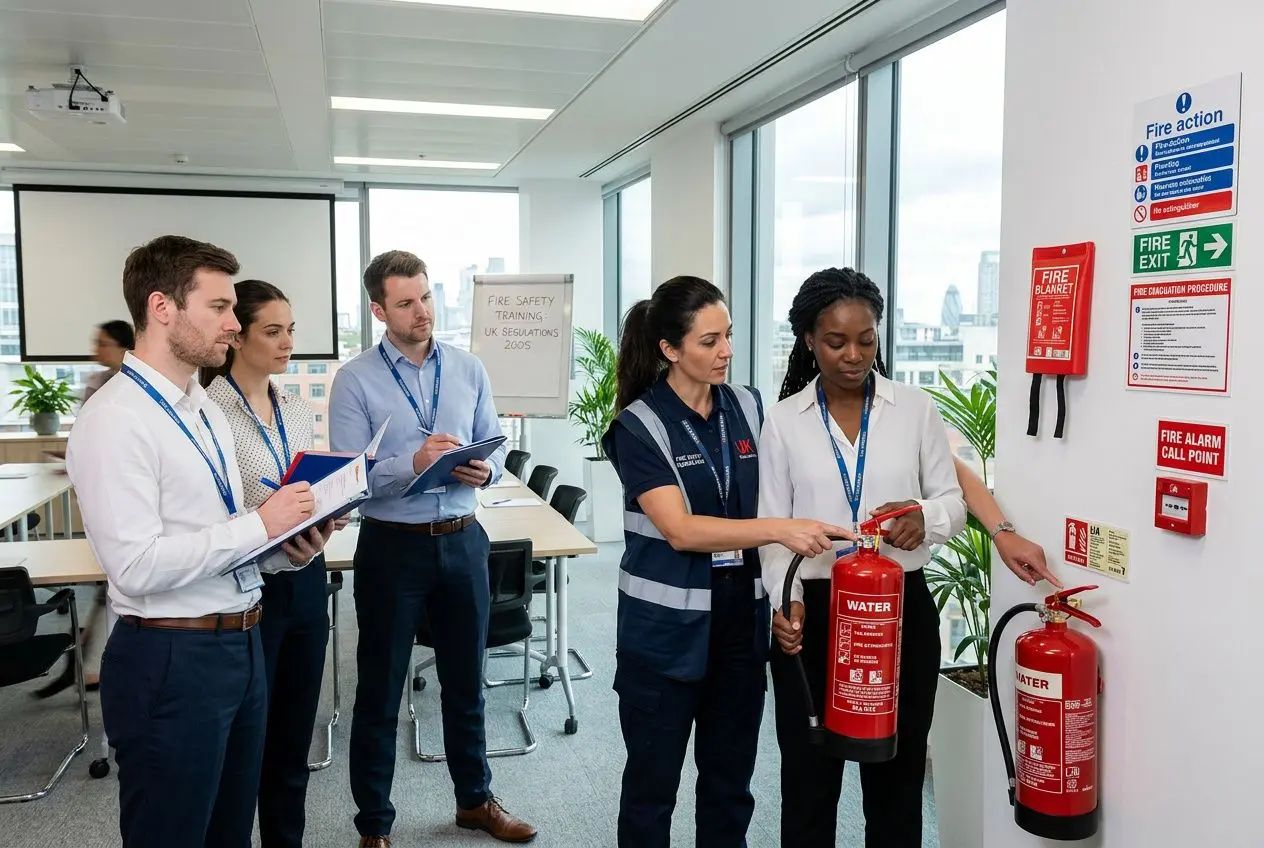
If you ask what are the legal requirements for fire safety, the answer starts with the responsible person. Under the Regulatory Reform (Fire Safety) Order 2005, this is the employer, owner, or occupier of non-domestic premises in England. The responsible person has legal duties for fire safety in the premises they control. The fire risk assessment UK requirement falls squarely on their shoulders.
- Employer: if you employ people and control the workplace, you will usually have fire safety duties.
- Owner or occupier: if you control non-domestic premises, you may be a responsible person.
- Competent fire risk assessor: the assessment should be carried out by someone with suitable knowledge, experience and understanding of the premises.
- Shared premises: where more than one responsible person has duties, cooperation and coordination are essential.
Where fire safety duties are not met, enforcement action can follow. In serious cases, this may include formal notices, prosecution, significant fines or, in exceptional cases, imprisonment. The fire safety regulations are not guidance, they are legal duties that regulators actively enforce.
Fire risk assessment duties every employer must fulfil
Meeting mandatory fire safety requirements means carrying out a suitable and sufficient fire risk assessment that is specific to your premises. Generic templates do not satisfy this duty. The assessment must identify significant hazards, evaluate existing controls, assess risk levels based on actual use, and produce clear, actionable recommendations. Assessments must be reviewed after significant changes to layout, occupancy, workforce or work activities, and following any fire incident.
From 1 October 2023, changes introduced through section 156 of the Building Safety Act 2022 strengthened fire safety duties. Responsible persons must now record their fire risk assessment and fire safety arrangements in full, regardless of the number of employees. Previously, documentation was only mandatory for organisations with five or more employees. This represents a significant shift. Use a fire safety checklist to support regular review and ensure nothing is missed between formal assessments.
Recent legislative changes affecting fire safety compliance
Recent changes have strengthened expectations around recording, cooperation and information sharing. For many employers, the practical message is simple: keep fire risk assessments current, document arrangements clearly, act on findings and review fire safety whenever the premises, occupancy, layout or work activity changes.
Some additional duties apply to specific residential buildings, particularly multi-occupied residential buildings and higher-risk buildings. If your organisation owns, manages or occupies this type of property, you may need more detailed advice.
Fire safety compliance requirements employers should maintain
Fire safety compliance is more than a folder of certificates. Your fire safety plan has to match today’s premises, people, shift patterns and risks. If a control only exists on paper, the regulator will treat it as missing. So will a fire.
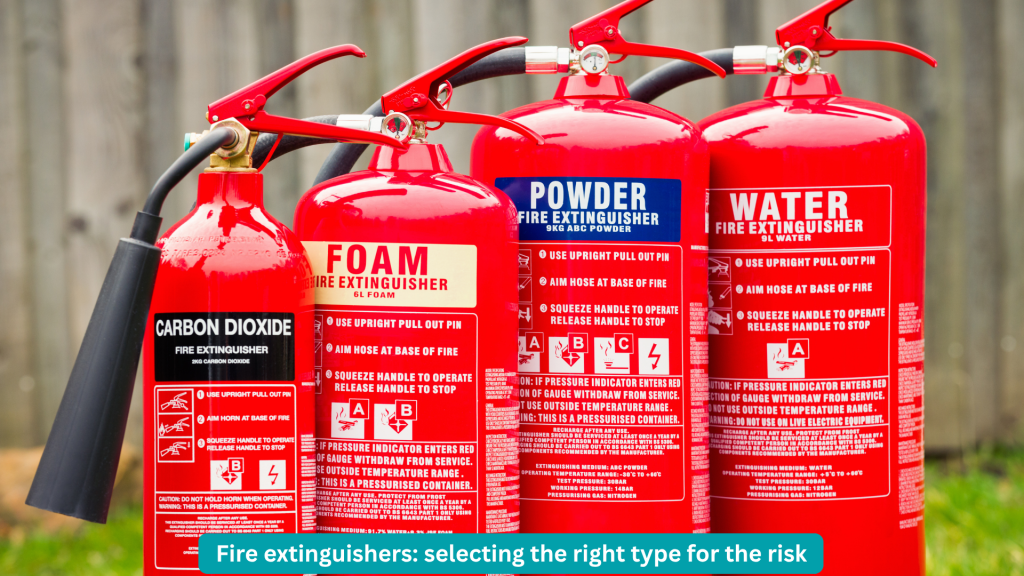
The type and location of extinguishers should reflect the fire risk assessment, the materials present and the layout of the premises.
Alarms, extinguishers and emergency lighting obligations
Every item of fire safety equipment, from the fire alarm system on the wall to the extinguisher by the door, sits under clear fire safety compliance requirements UK businesses must meet. Specification, installation, testing and maintenance all matter.
- Fire alarm system testing Checks, testing and servicing should be planned according to the premises, equipment type, relevant standards and competent advice. As a minimum, employers should be able to show that fire alarms, extinguishers, emergency lighting and fire safety signage are inspected, maintained and reviewed at suitable intervals. Keep the logbook up to date; inspectors will ask.
- Extinguisher maintenance Select the right medium for each area, mount units correctly and book an annual service. This addresses fire extinguisher compliance requirements and keeps insurance valid.
- Emergency lighting checks Do a monthly “flick” test and an annual three-hour drain test. Lighting is mandatory wherever a power cut would leave escape routes in darkness.
- Fire safety signage Position action notices, exit signs, extinguisher IDs and call-point signs where they are obvious and legible. Check them when you walk the floor.
Review provision whenever the building or its use changes. A workshop converted to storage can alter the risk profile overnight.
| Equipment type | Testing frequency | Service frequency | Competent person required |
| Fire alarm system | Weekly | 6-monthly | Yes |
| Portable fire extinguishers | Visual check routinely | Annual | Yes |
| Emergency lighting | Monthly | Annual full service | Yes |
| Fire door | Routine visual checks | Regular detailed inspection | Yes |
Escape routes, fire doors and evacuation arrangements
Blocked exits remain the top breach. Clearing a path costs nothing and meets both the Fire Safety (England) Regulations and common sense. Keep corridors, stairs and external routes free of stock, packaging and personal items.
Fire doors also need more than a quick glance. The responsible person should make sure fire doors are checked regularly and that defects are acted on. In many workplaces this means routine visual checks by staff, plus a more formal inspection by a competent person where doors are damaged, heavily used, part of a key escape route or where the fire risk assessment identifies the need. For some multi-occupied residential buildings in England, specific fire door check frequencies apply, including quarterly checks of communal fire doors and annual checks of flat entrance doors.
Fire door integrity is critical. Doors must shut fully, seals must be intact and gaps kept tight. In residential buildings above 11 metres, the Fire Safety (England) Regulations demand annual checks of flat entrance doors and quarterly checks of common-area doors. Failures trigger immediate action: wedges out, closers repaired, frames replaced.
Evacuation only works when people know what to do. Run drills, capture feedback, update the procedure and brief new starters.
Regulators do not expect perfection, but they do expect responsible persons to understand the risks, maintain suitable controls and act when problems are identified.
Training, records and common fire safety gaps
What matters is whether people understand fire safety requirements in practice, whether the responsible person has clear oversight, and whether actions from each assessment are followed through. This is where many organisations in England fall short, and where gaps in compliance can build up quickly.
Staff training, fire marshals and evacuation support arrangements
To achieve compliance with fire safety regulations, staff must understand how to respond to fire risk in their own workplace. That starts at induction and continues through regular refresher training. Training should always be specific to the premises, the layout, the people at risk and the nature of the work. A generic slide deck is not enough.
As a minimum, employees should receive fire safety instruction before working unsupervised, with refresher training delivered at least annually. Training should also be updated when there is a significant change to the premises, staffing profile, processes or evacuation routes. Good records matter here. If training has not been documented, it becomes difficult to show that fire safety arrangements have been properly implemented.
- Induction training New starters should receive clear, premises-specific fire safety information before they begin work without supervision.
- Annual refresher training Regular refreshers help people stay familiar with procedures, assembly points, alarm arrangements and any changes affecting evacuation.
- Fire marshal appointments Fire marshals should be trained by a competent person so they can support evacuation, assist with sweep procedures where appropriate, liaise with emergency services and understand the limits of extinguisher use.
- Personal Emergency Evacuation Plans PEEPs should be in place for anyone who may need support to evacuate safely and without delay.
Missing PEEPs remain one of the most serious weaknesses seen in workplace fire risk assessment reviews. If someone cannot leave the premises independently, the responsible person must have a realistic and documented plan in place. Employers also need to provide fire safety information in a way people can understand and use.
Review PEEPs whenever there is a relevant change. That could be a change in health, a new starter, alterations to the building, a revised escape route or new working patterns. The Regulatory Reform (Fire Safety) Order, the Fire Safety Act 2021 and the Fire Safety (England) Regulations 2022 all require the same thing: arrangements must reflect the actual building and the actual people using it.
Common gaps undermining compliance with fire safety regulations
Fire safety reviews and enforcement cases often highlight the same practical weaknesses. Many organisations have documents in place, but those documents no longer match day-to-day reality. That creates avoidable fire risk and exposes the business to scrutiny if there is an incident or inspection.
- Outdated fire risk assessment records A fire risk assessment should reflect current use of the premises, occupancy levels, layout and work activity. If it does not, the assessment is unlikely to support sound decision-making.
- Blocked escape routes Poor housekeeping, temporary storage and equipment left in circulation areas can quickly compromise evacuation.
- Weak fire door checks A fire door only works if it is in good condition, closes properly and has not been wedged open or damaged.
- Unclear ownership of actions When responsibilities are vague, actions remain open, deadlines slip and fire safety measures are not maintained.
One of the clearest signs of weak fire safety management is poor follow-up. Actions raised during an inspection, drill or fire risk assessment need an owner, a deadline and confirmation that they have been completed. Without that, organisations are left with a list of known issues and no reliable way of reducing risk.
Inspections, records and follow-up action
Inspections work best when they reflect normal conditions. They are also one of the simplest ways to spot whether fire safety measures are slipping over time. A structured fire safety checklist can help make these checks more consistent.
Records should be clear and usable. That includes the date, location, what was checked, issues found, actions required, the named responsible person for each action and the timescale for completion. Senior oversight matters too. If the same issues keep appearing, the problem may sit with supervision, maintenance, training or the wider fire safety management system rather than with one isolated task.
Organisations should retain records of each fire risk assessment, training activity, drill, maintenance check and action plan in a way that can be accessed when needed. This supports compliance with fire safety regulations and helps demonstrate that fire safety arrangements are being actively managed.
For some buildings, including certain residential or higher-risk buildings, wider building safety duties may also affect record keeping, accountability and information sharing. The Building Safety Act 2022, along with related England regulations, has increased focus on record keeping, accountability and the management of building risks in England. For many duty holders, that means taking a more structured approach to assessment, inspection and evidence. Depending on the type of premises, this may sit alongside duties under the Fire Safety Act and other UK fire safety requirements.
If you are unsure whether your current system is robust, an independent review can help. Salusphere Global supports organisations with fire risk assessments, workplace risk assessments, competent person advice and fractional Health and safety support support. We help employers identify gaps, improve fire safety arrangements and prioritise practical action.
Once you understand your legal duties, the next step is making sure your Fire Risk Assessment is not just present, but genuinely useful. Read our follow-up article: Fire Risk Assessments: Why Having One Is Not Always Enough.
Frequently asked questions
What is the main fire safety legislation employers in England must comply with?
The cornerstone of fire safety law in England is the Regulatory Reform (Fire Safety) Order 2005. Under this Order, the responsible person must carry out and regularly review a suitable and sufficient fire risk assessment and maintain appropriate fire safety arrangements. Since Grenfell, several Acts have tightened requirements. The Fire Safety Act 2021 clarified that the external walls, structure and flat entrance doors of residential buildings are in scope. The Building Safety Act 2022 and the Fire Safety (England) Regulations 2022 add extra duties for multi-occupied residential buildings, including the need for documented assessments and regular information sharing with residents.
How often does a fire risk assessment need to be reviewed?
Legislation does not set a rigid timetable. The Fire Safety Order simply says the assessment must stay current. In plain terms, review it whenever something important changes—layout alterations, new processes, higher occupancy, staff turnover or after any fire. Many organisations schedule regular reviews as a backstop, then carry out ad hoc checks when change occurs. If the document no longer mirrors reality, you are out of step with fire safety legislation and at risk of enforcement.
What are the most common fire safety compliance gaps found during UK workplace inspections?
Inspectors keep seeing the same problems: outdated assessments, blocked escapes, neglected fire door checks, inadequate evacuation drills and missing PEEPs. Training records can look impressive on paper, yet staff may freeze in a real alarm. Another frequent gap is muddled ownership—nobody quite knows who does what, so follow-up actions stall.
For an external view, Salusphere Global can review your fire safety arrangements, identify gaps and prioritise proportionate next steps, from improving drills and documentation to arranging a suitable fire risk assessment.