

Table of Contents
This workplace mental health guide gives HR leaders, managers, and business owners a clear, practical framework for understanding mental health at work, recognising early warning signs, meeting legal duties, and building lasting support structures that protect both people and organisational performance.
Understanding workplace mental health and its impact
Mental health affects performance, attendance, retention, culture and day-to-day decision-making. It sits at the centre of health at work, employee wellbeing and organisational resilience.
Mental health and wellbeing are shaped by the work environment, leadership behaviour, workload, relationships and the level of support available when people face pressure. If these factors are poorly managed, work-related stress can build quickly and lead to wider mental health challenges.
What is workplace mental health?
Workplace mental health describes how people think, feel and function at work. It includes how well they cope with everyday demands, manage pressure, maintain working relationships and stay engaged in their role. It can change over time and may be influenced by both work and life outside work.
That matters because a mental health problem does not always look obvious. Signs can appear gradually. A person may struggle with concentration, become less decisive, withdraw from colleagues or find routine tasks harder than usual. Anxiety and depression may develop quietly, especially where people feel unable to speak openly.
Supporting employee mental health early is a practical part of managing workplace mental health, not simply a wellbeing add-on.
Key workplace mental health statistics UK employers should know
In 2024/25, work-related stress, depression or anxiety accounted for 22.1 million working days lost in Great Britain. HSE also reported 964,000 workers suffering from work-related stress, depression or anxiety.
Mental health problems are common. Mind reports that around one in four people experience a mental health problem of some kind each year in England, meaning most organisations are likely to have employees affected by mental health concerns at some point.
The drivers are often familiar: excessive demands, unrealistic targets, weak line management, poor working relationships, low control over tasks and badly handled change.
The real cost of poor mental health at work
The cost is not limited to absence. Presenteeism, where people are at work but not functioning effectively, is often the larger cost. UK businesses are estimated to lose £25 billion a year through reduced focus, poor decision-making and lower output linked to work-related stress, anxiety and depression.
There is also a wider effect on teams. Poor mental health and wellbeing can weaken morale, increase mistakes, damage working relationships and place extra pressure on colleagues. Over time, that can affect service quality, retention and culture.
Research also suggests that for every £1 invested in relevant support, employers may see an average return of £5.30 through lower absence, reduced presenteeism and better retention.
For employers, the takeaway is clear: review the risks in your work environment, train every manager to spot early signs, and build a practical approach to workplace mental health that helps prevent work-related stress.
If you want an informed view of where the gaps are, Salusphere Global can help through workplace risk assessments, wellbeing needs assessments, mental health training and fractional senior support.
Recognising early signs of poor mental health at work
Spotting problems early can prevent a difficult situation becoming a prolonged absence, a performance issue or a wider team problem. For any manager, recognising the signs of poor mental health is a practical part of supporting health at work. In many organisations, workplace stress and mental health concerns do not appear suddenly. They tend to show up through small changes in behaviour, energy, attendance and performance over time.
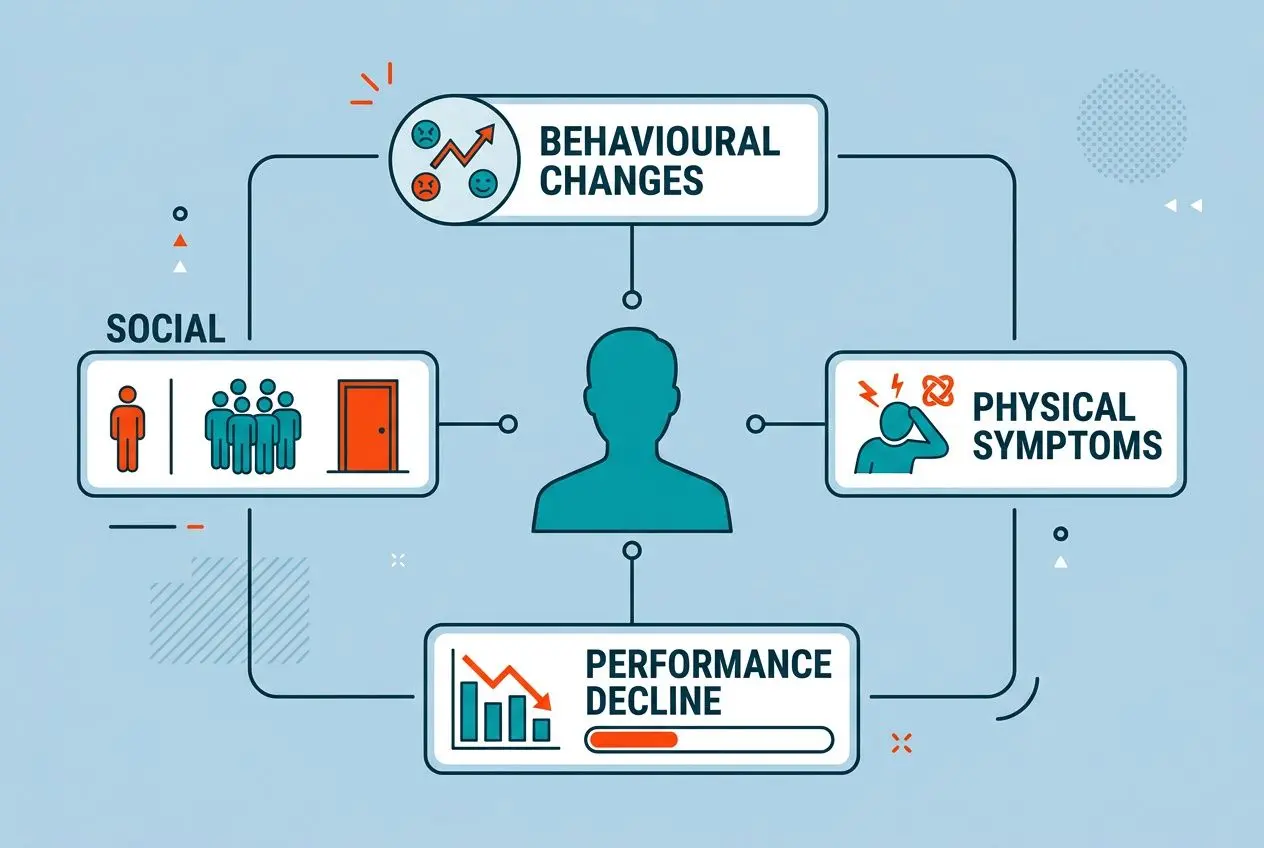
Behavioural and physical warning signs to look out for
The signs of poor mental health are rarely limited to one issue. More often, they appear as a pattern. That pattern may affect behaviour, physical wellbeing, concentration and work quality.
- Behavioural shifts: Irritability, tearfulness, social withdrawal, disengagement, unusual mistakes or missed deadlines can all indicate that someone is struggling with stress and mental health.
- Physical symptoms: Headaches, ongoing fatigue, poor sleep, difficulty concentrating and unexplained weight changes are common signs of poor mental health.
- Performance changes: A clear drop in output, quality or reliability, especially in someone who is usually consistent, may point to mental health at work concerns rather than a capability issue.
- Attendance patterns: Repeated lateness, short-term absence or a sudden need to avoid the workplace can suggest growing workplace stress or burnout.
A single bad day proves very little. Regular one-to-ones give a manager space to notice what is changing, ask sensible questions and support better health in the workplace without becoming intrusive.
How to spot burnout before it becomes a crisis
Burnout is linked to chronic workplace stress that has not been managed effectively. It often develops gradually. People may first seem tired, detached or less confident in their work. Over time, energy drops further, cynicism increases and day-to-day tasks can start to feel unmanageable.
Common causes include long hours, too few breaks, unrealistic workloads, poor communication, conflicting priorities and a culture where people feel unable to speak up. This is where mental health at work overlaps directly with leadership, workload planning and risk management. A manager who pays attention to these conditions is in a much stronger position to reduce harm before someone reaches crisis point.
Talking about mental health with a colleague
Talking about mental health does not require clinical training. It does require care, privacy and good judgement. Choose a quiet setting, ask open questions and give the person time to answer. Keep the conversation simple. Listen properly.
That means paying attention, avoiding rushed reassurance and not leaping straight into solutions. The aim is not to fix everything there and then. It is to understand what may be happening, identify any immediate concerns and agree sensible next steps.
If you are unsure how to proceed, involve the right support. That may include HR, occupational health, employee assistance provision or a trained mental health first aid contact. Mental health first aid can help people respond appropriately, but it does not replace management responsibility for workload, communication and support. Where there are clear signs of poor mental health, early action is usually far more effective than waiting.
For employers, the message is straightforward: train managers, encourage talking about mental health, review the causes of workplace stress and make support routes clear. If you want to review your current approach to stress and mental health, mental health awareness training or wider health and safety arrangements, Salusphere Global can help you identify gaps, prioritise action and improve health in the workplace.
Manager responsibilities and legal duties for workplace mental health
Line managers sit at the heart of any effective workplace mental health approach. They are often the first to notice change, the first point of contact for employees in difficulty, and the people most responsible for shaping the daily work environment. Understanding both the legal framework and practical expectations is essential for any manager in a position of people responsibility.
Employer legal obligations under UK health and safety law
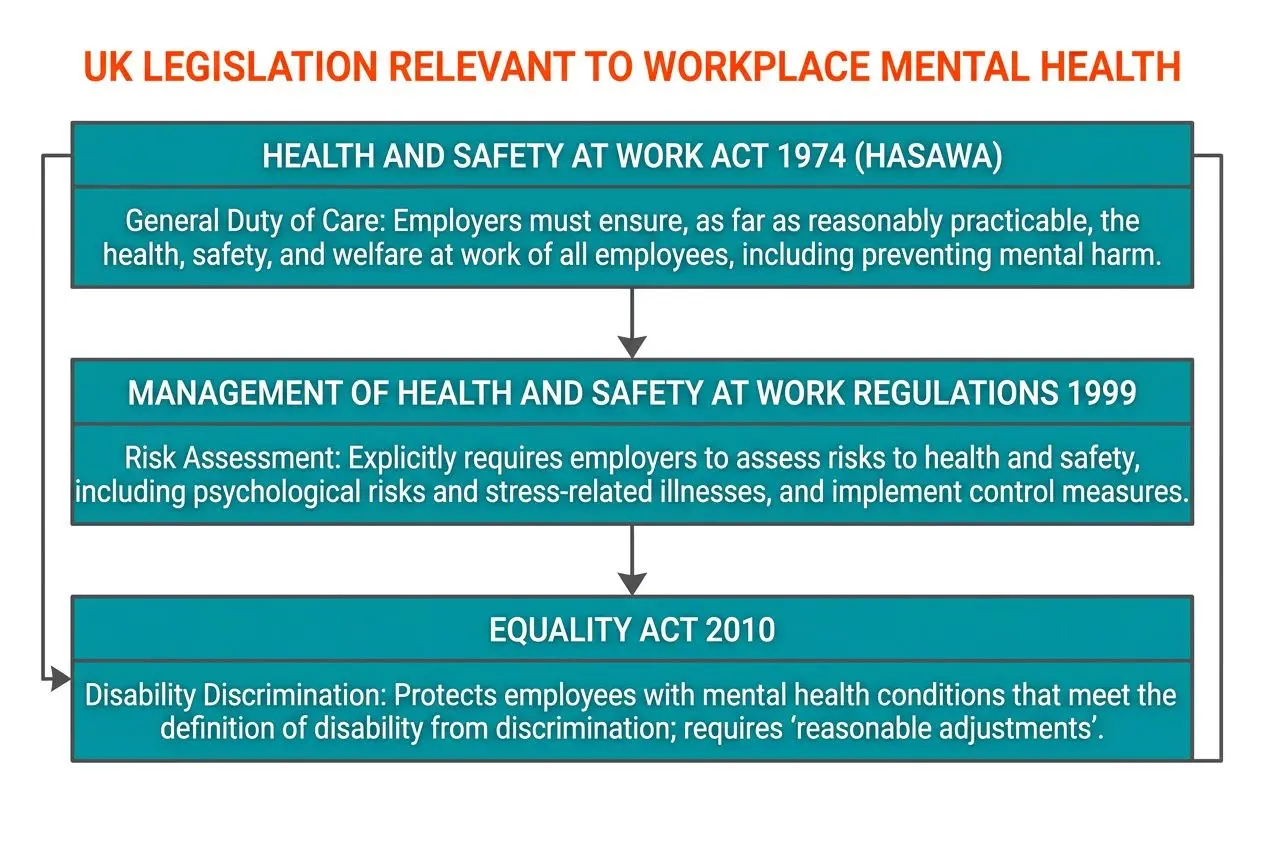
Manager responsibilities in relation to mental health are underpinned by clear legal duties. The Health and Safety at Work Act 1974 requires employers to protect the health, safety, and welfare of all employees, including their mental health. Where employers fail to manage foreseeable risks, this can create legal, operational and people-related consequences. Employers have duties to assess and manage risks to health and safety, including work-related stress where it is a foreseeable risk. HSE’s Management Standards provide a useful framework for looking at six areas of work design: demands, control, support, relationships, role and change.
The Equality Act 2010 adds further obligation. Mental health conditions with a long-term impact on daily life may qualify as a disability, requiring employers to make reasonable adjustments and protect staff from discrimination. Occupational health support and referral pathways should be part of every organisation’s response toolkit, not an afterthought. The guidance on mental health at work from the HSE outlines how organisations must treat mental health as a safety hazard and apply the Management Standards framework accordingly.
How managers can build psychologically safe environments
Psychological safety, the belief that one can speak up, raise concerns, or admit difficulty without fear of negative consequences, is not a soft concept. Research consistently shows that employees whose line managers actively support their mental wellbeing are more than twice as likely to report good mental health outcomes. The manager’s behaviour is the single most influential factor in whether that safety exists.
Practical steps include regular, informal check-ins alongside formal one-to-ones, normalising discussions about pressure and workload, and treating employees as individuals rather than resources. A manager who models healthy working habits, including respecting work-life balance and taking breaks, sets the tone for the whole team.
The HSE’s management standards address six areas of work design: demands, control, support, relationships, role, and change. Using these as a framework gives managers a structured, evidence-based method for identifying and reducing stressors before they cause harm. Salusphere Global helps organisations apply this framework through workplace wellbeing needs assessments and tailored consultancy support.
Leadership behaviour and its impact on team wellbeing
Senior leaders shape culture more than any policy document. When leadership teams openly discuss mental health, take time off when unwell, and respond to employee concerns with empathy rather than performance pressure, it signals that wellbeing is genuinely valued. Core values and wellbeing commitments carry no weight if senior management do not practise them. Occupational health support, manager training, and leadership development must work together to create an environment where people can perform sustainably.
Practical workplace mental health resources and strategies
Good intentions are not enough. If an organisation wants to improve employee mental health, reduce burnout and build a supportive workplace, it needs a clear mental health strategy, practical health resources and reliable health support that people can actually use.
It should link legal duties, day-to-day management, health in the workplace and wider health and wellbeing goals, rather than treating workplace mental health as a stand-alone initiative.
Building a mental health strategy and a supportive workplace
Effective workplace mental health resources start with leadership. Not with an app. Not with a one-off awareness day. A credible mental health strategy needs visible commitment from senior leaders, clear communication, and managers who understand their role in supporting mental health.
That also means having the right foundations in place: documented policies, regular review points, sensible risk assessment processes and a clear route to mental health support when people need it. Our mental health guide explains how a structured consultancy approach can help organisations assess gaps, prioritise action and strengthen workplace mental health over time.
- Mental health policy: A clear written commitment to employee mental health, setting out available support, responsibilities and expectations across the organisation.
- Stress Risk Assessment: A legal requirement under the Management of Health and Safety at Work Regulations 1999, used to identify and reduce causes of work-related stress at organisational, team and individual level.
- Wellbeing awareness calendar: Planned activity across the year, including short learning sessions and communications that keep mental health and wellbeing visible without overwhelming people.
- Employee engagement survey: Regular feedback to understand mental health challenges, inclusion issues and where further resources or intervention may be needed.
There is also a strong commercial case. Employees who believe their employer genuinely cares about their wellbeing are less likely to leave, less likely to experience burnout and more likely to stay engaged. In practice, a strong mental health strategy supports retention, performance and culture as much as it supports health and wellbeing.
| Strategy element | Purpose | Review frequency |
| Mental health policy | Sets organisational commitment and available mental health support | Annual minimum |
| Stress Risk Assessment | Identifies and reduces work-related stressors | Regularly and after significant change |
| Wellbeing needs assessment | Highlights gaps, priorities and practical health resources | At the outset and annually |
| Employee engagement survey | Measures views on mental health and wellbeing, inclusion and support | Every six months or annually |
| Manager training | Builds confidence to spot concerns, respond appropriately and signpost health support | On appointment and refreshed regularly |
Workplace mental health resources employees can actually use
A practical mental health strategy should not sit only with HR or a manager. Employees need direct access to workplace mental health resources that help them manage pressure, raise concerns early and find the right health support before problems escalate.
The CIPD’s mental health guide is a useful reference point for organisations developing workplace mental health resources, prevention measures and manager-led support.
- Wellness Action Plans: Practical documents that help an employee and manager agree triggers, helpful adjustments, warning signs and ongoing mental health support.
- Employee Assistance me (EAP): Confidential employee assistance and health support, often including a helpline, short-term counselling and specialist signposting for personal or work-related concerns.
- Digital tools and mental health resources: Self-help materials, guidance notes, peer support options and other resources that give people somewhere to turn between formal interventions.
Strong workplace mental health usually depends on layers of support: employee assistance, practical mental health resources, informed management, peer support and a culture where asking for help is treated as normal.
Training, capability and early intervention
A manager may be the first person to notice changes in behaviour, attendance or performance, so their capability to recognise and respond to mental health concerns is essential.
Mental Health First Aid training can help nominated staff recognise distress, respond calmly and signpost colleagues towards appropriate mental health support and other mental health resources. Used well, mental health first aid strengthens early intervention, but it should sit within a wider mental health strategy rather than replace it.
Where suicide risk is a concern, Suicide First Aid training gives staff a structured framework for recognising warning signs, having difficult conversations and helping someone access urgent support safely.
For many organisations, the wider picture also includes leadership development, line manager capability, neurodiversity support, and a review of whether current workplace mental health resources are fit for purpose. That is often where an external perspective helps. Salusphere Global supports organisations with workplace wellbeing needs assessments, training and fractional senior support to identify gaps, strengthen systems and improve mental health and wellbeing in a way that fits the reality of the business.
What employers should take away
If you want to improve workplace mental health, start with the basics and do them properly. Put a clear mental health strategy in place. Make sure every manager understands their role. Review stress risks. Check whether your employee assistance offer, health resources and health support are accessible and trusted. Then build from there.
The goal is a workplace where mental health challenges are identified early and people know what support is available, not one where good intentions are buried in unused policies.
If you want to review your current approach to workplace mental health, strengthen your mental health and wellbeing provision, or assess whether your existing resources are doing what they should, speak to Salusphere Global about consultancy, training or fractional support.
Frequently asked questions
What are the legal duties of employers regarding mental health at work?
Employers in the UK are legally required under the Health and Safety at Work Act 1974 to protect the health, safety, and welfare of all employees, including their mental health. The Management of Health and Safety at Work Regulations 1999 requires documented Stress Risk Assessments. The Equality Act 2010 means that mental health conditions with long-term impact may qualify as a disability, requiring reasonable adjustments. Non-compliance can result in unlimited fines or prosecution. Organisations should conduct regular audits and gap analyses to ensure their approach meets current legal and best practice standards.
How can a manager support employee mental health effectively?
A manager plays a critical role in supporting employee mental health day to day. Practical steps include holding regular, informal check-ins alongside formal one-to-ones, normalising conversations about pressure and workload, modelling healthy work-life balance, and responding to early signs of difficulty with curiosity rather than judgement. Managers should be trained to recognise behavioural and physical warning signs, have access to clear escalation pathways, and know how to signpost colleagues to health support such as Mental Health First Aiders or Employee Assistance mes. Leadership behaviour sets the tone for the entire team culture.
What practical steps can organisations take to improve mental health and wellbeing at work?
Organisations should start with a wellbeing needs assessment to identify gaps and priorities specific to their workforce. From there, the most effective steps include developing a documented mental health policy, completing Stress Risk Assessments, training managers and Mental Health First Aiders, and establishing peer support structures. Making employee assistance and occupational health support easily accessible, alongside digital tools such as Wellness Action Plans, builds a layered approach. Salusphere Global helps organisations identify gaps, prioritise action, improve systems, and reduce risk through tailored consultancy and training rather than generic, off-the-shelf solutions.