

Meeting health and safety requirements for a small business can feel complicated, but the essentials are straightforward once you understand your responsibilities and put proportionate arrangements in place.
Health and safety duties for small businesses
UK health and safety law places duties on every employer, whatever the size of the organisation. The practical arrangements you need will depend on your activities, workforce and level of risk.
Our health and safety consultancy for UK employers supports businesses at different stages of that process.
Who must comply with health and safety law?
Every employer has health and safety responsibilities towards their employees and others who may be affected by their work. This applies whether you employ one person or hundreds.
The HSE’s health and safety basics for your business provides practical guidance for small employers. Self-employed people can also have health and safety duties where their work creates a risk to others.
- Full-time and part-time employees: Employer duties apply regardless of contracted hours.
- Temporary and agency workers: Appropriate arrangements need to be in place for people working temporarily or through an agency.
- Work-experience placements: Employers need to consider the health and safety of young people and students undertaking work experience.
- Directors and senior managers: Leadership decisions influence how effectively health and safety is managed in practice.
Depending on the type of workplace and activity, health and safety law may be enforced by the Health and Safety Executive (HSE) or the relevant local authority. For most small businesses, however, the immediate priority is making sure day-to-day arrangements are suitable, proportionate and actually followed.
Fractional health and safety leadership for SMEs can give a growing business access to experienced support without requiring a full-time health and safety appointment.
Seven core areas to consider
A useful way for a small business to organise its approach is to consider seven core areas. This is a practical framework rather than a separate legal checklist, helping you identify where arrangements are already working and where further attention may be needed.
You can start by using our health and safety compliance checklist. It can help highlight potential gaps and provides the option of a free specialist review if you would like help interpreting the results.
The level of detail required will depend on your business. A low-risk office will have different requirements from a manufacturing operation, construction business or mobile trade. The important point is to make arrangements that reflect how your organisation actually operates.
| Core area | What it involves | Key point |
|---|---|---|
| Health and safety policy | Statement of intent, responsibilities and arrangements | Must be written down if you employ five or more people |
| Risk assessment | Identifying hazards, who may be harmed and suitable controls | Significant findings must be recorded if you employ five or more people |
| Competent person | Someone with the skills, knowledge and experience to help manage health and safety | Every employer must appoint competent help |
| Training and consultation | Suitable information, instruction, training and worker involvement | Arrangements should reflect the work and risks involved |
| First aid and welfare | Appropriate first-aid arrangements and workplace welfare | Provision should reflect your circumstances and first-aid needs assessment |
| Emergency arrangements | Fire precautions, evacuation and other relevant emergency procedures | Arrangements should reflect foreseeable emergencies and applicable requirements |
| Accidents and incidents | Recording, investigation and reporting where required | Certain work-related incidents must be reported under RIDDOR |
The HSE’s guidance on preparing a health and safety policy explains what a policy should contain and provides a useful starting point.
Work through these areas proportionately rather than trying to create unnecessary paperwork. If you identify gaps that you are not confident dealing with internally, competent health and safety advice can help you prioritise what needs attention.
Competence, training and consultation
Every employer must appoint a competent person to help them meet their health and safety duties. This could be the employer, one or more suitably competent employees, someone from outside the business, or a combination of these.
What matters is that the person has the skills, knowledge and experience needed for the risks and activities involved. Where that capability is not available internally, external support can provide additional expertise.
Employees also need suitable information, instruction, training and supervision so they understand the risks associated with their work and the precautions they should follow. Employers must consult workers on health and safety matters and should provide clear ways for concerns to be raised and addressed.
Creating a health and safety policy
A health and safety policy should explain how your organisation manages health and safety in practice. It provides clarity about responsibilities, arrangements and the standards people are expected to follow.

When a written policy is required
If you employ five or more people, your health and safety policy must be recorded in writing. Businesses with fewer than five employees still need suitable health and safety arrangements, even though the policy itself does not have to be written down.
The HSE provides a health and safety policy template that can be a useful starting point. Whatever format you use, it should reflect your actual organisation, activities and risks rather than remaining a generic document.
- Five or more employees: Your health and safety policy must be recorded in writing.
- Fewer than five employees: You still need appropriate arrangements, although the policy does not have to be written down.
Even where it is not legally required, documenting your arrangements can help clarify responsibilities, provide consistency and make it easier to review how health and safety is being managed.
The three essential policy sections
HSE guidance structures a health and safety policy around three main areas:
- Statement of intent: Sets out your general approach and commitment to managing health and safety.
- Responsibilities: Identifies who is responsible for specific health and safety activities and decisions.
- Arrangements: Explains what you will do in practice to manage risks, including relevant assessments, training, maintenance, consultation and emergency arrangements.
Fire safety and other specific arrangements should be addressed where relevant to your premises and activities. Responsibilities should be clear so that important actions are not assumed to belong to somebody else.
Keep the policy current. Review it when significant changes take place and periodically to make sure it still reflects how the organisation operates.
Risk assessment and incident controls
Risk assessment is a practical part of managing health and safety. It helps you identify what could cause harm, who may be affected and whether the precautions already in place are sufficient.
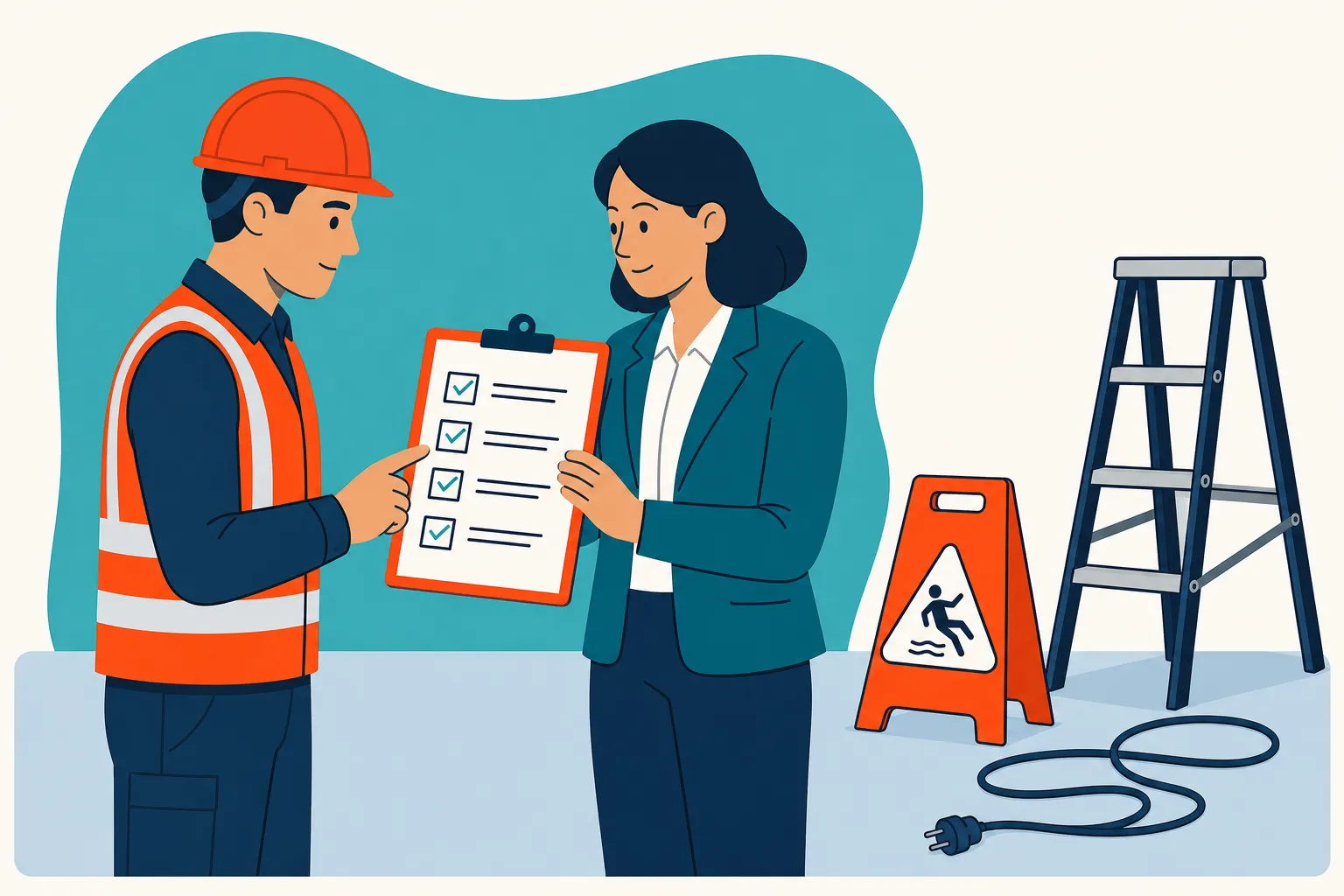
Completing a risk assessment
Employers need to assess risks to employees and others who may be affected by their work. The assessment should be proportionate to the nature of the business and the risks involved.
- Identify hazards: Consider work activities, equipment, substances, the workplace and anything else that could realistically cause harm.
- Consider who may be harmed and how: Include employees and, where relevant, contractors, visitors, members of the public and people who may be particularly vulnerable.
- Evaluate the risks and controls: Consider what precautions are already in place and whether further action is reasonably required to control the risk.
- Record and review: If you employ five or more people, record the significant findings. Review assessments when circumstances change or when there is reason to believe they may no longer be valid.
Businesses with fewer than five employees still need to assess their risks, even though they are not required to record the significant findings. Keeping a proportionate written record can nevertheless be useful for maintaining consistency and demonstrating what has been considered.
First aid and emergency readiness
Employers must provide appropriate first-aid arrangements for their workplace. What is required should be determined through a first-aid needs assessment that considers factors such as the type of work, workplace hazards, workforce size and working arrangements.
Provision may include an appropriately stocked first-aid kit, an appointed person to take responsibility for first-aid arrangements and, where the needs assessment identifies it, suitably trained first aiders. Employees should know what arrangements are in place and how to obtain help.
Emergency arrangements should also reflect the risks associated with your workplace and activities. This may include fire procedures, evacuation arrangements, assembly points and clear responsibilities for responding to foreseeable emergencies.
Communicate these arrangements clearly and review them when premises, activities, workforce arrangements or risks change.
Frequently asked questions
What should a small business consider when managing health and safety?
A practical starting point is to consider your health and safety policy, risk assessments, access to competent advice, training and worker consultation, first aid and welfare, emergency arrangements, and how accidents and incidents are recorded, investigated and reported where required.
The exact arrangements should be proportionate to your activities, workforce and level of risk rather than based on the size of the business alone.
Do health and safety duties apply if I only have one or two employees?
Yes. Employers have health and safety duties regardless of the size of their workforce. A smaller business still needs to identify relevant risks and take appropriate steps to manage them.
If you employ fewer than five people, you do not have to record your health and safety policy or the significant findings of your risk assessment in writing, but the underlying duties still apply.
What is the difference between a competent person and an external health and safety consultant?
A competent person is someone appointed to help an employer meet their health and safety duties. They need the skills, knowledge and experience appropriate to the work and risks involved.
The competent person may be the employer, an employee or somebody from outside the organisation. An external health and safety consultant can be useful where the required expertise or capacity is not available internally.
External support might include reviewing existing arrangements, assisting with risk assessments, developing policies and procedures, providing training or giving practical advice on particular risks. For some growing businesses, a fractional health and safety arrangement can provide ongoing senior support without creating a full-time role.