Table of Contents
- What does the law require for a COSHH risk assessment?
- COSHH and DSEAR: When Both Assessments Are Needed
- How to complete a COSHH assessment
- Putting assessment findings into practice
- Managing spills, accidents and emergency incidents
- Recording, checking and reviewing findings
- Examples across four workplace settings
- Frequently Asked Questions
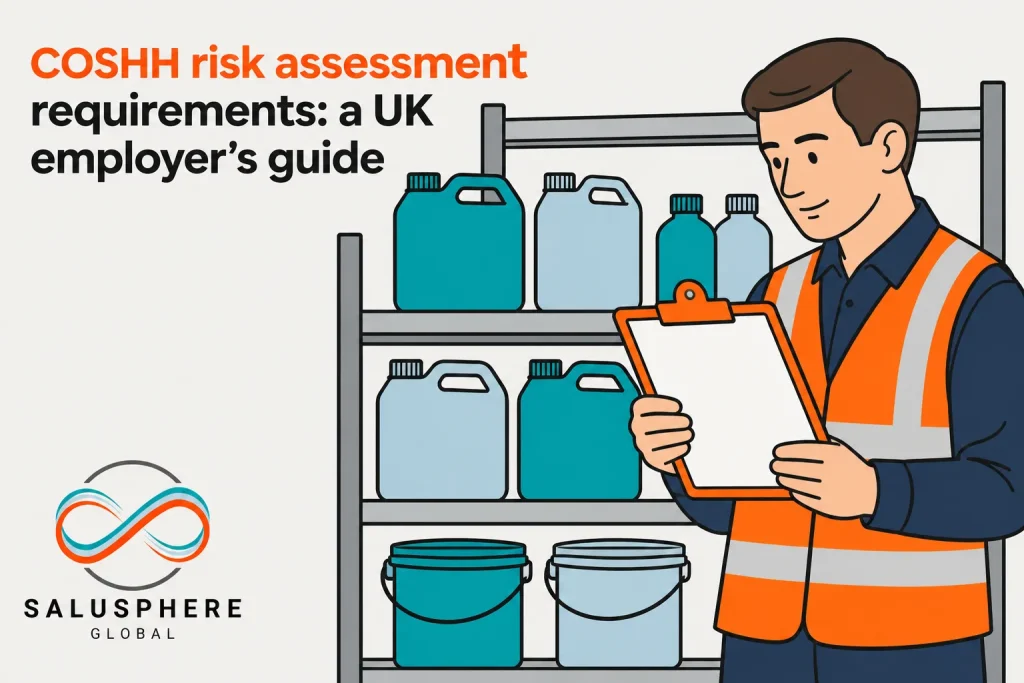
COSHH risk assessment requirements can seem complicated, but the underlying legal duties are straightforward. The challenge for employers is applying them correctly to real workplace activities. This guide covers the law and who is responsible. It then works through each step of the assessment, the controls, training and health surveillance it leads to, and how to record and review your findings. Examples from manufacturing, engineering, cleaning and hospitality show how it works in practice.
What does the law require for a COSHH risk assessment?
COSHH stands for the Control of Substances Hazardous to Health. It sits alongside wider health and safety law and deals with one question: could the work harm someone’s health through a hazardous substance? If it could, you need to assess the work and act on what you find before the work starts.
The legal duties and their scope
Regulation 6 of the COSHH Regulations 2002, as amended, sets the core legal requirement for a COSHH risk assessment. Where work is liable to expose employees to substances hazardous to health, the employer must make a suitable and sufficient assessment. The measures it identifies must then be in place before the work begins.
This duty sits within a wider framework. Regulation 3 of the Management of Health and Safety at Work Regulations 1999 sets the general risk assessment duty. The COSHH regulations add specific duties on health risks from hazardous substances. Fire and explosion risks from dangerous substances come under a separate duty in DSEAR regulation 5.
COSHH does not cover lead, asbestos or radioactive substances, which each have their own regulations. Northern Ireland also has its own legal framework, so do not assume that guidance written for Great Britain applies there unchanged.
COSHH and DSEAR: When Both Assessments Are Needed
Some hazardous substances create more than one type of risk. A solvent, for example, may cause respiratory or skin problems through exposure, while its flammable vapours may also create a fire or explosion hazard.
COSHH addresses the risks to health from hazardous substances. DSEAR (Dangerous Substances and Explosive Atmospheres Regulations 2002) addresses safety risks arising from fire, explosion and certain other dangerous properties.
Where both sets of regulations apply, employers must consider both types of risk. The assessments can be coordinated or combined where appropriate, provided all relevant legal requirements are addressed.
Common examples include paint spraying, solvent storage, welding gases and processes that generate combustible dust.
At Salusphere Global, our Head of Risk & Compliance, Tim Hassall, can support organisations with COSHH and DSEAR risk assessments, helping identify hazardous substances, evaluate workplace risks and recommend proportionate control measures.
We’ll explore DSEAR responsibilities, hazardous-area classification and practical assessment requirements in a separate guide.
Who assesses and who remains responsible?
The duty to assess applies to every employer, however small. If you have five or more employees, you must also record the significant findings and the steps taken to prevent or control exposure. The HSE’s frequently asked questions on COSHH confirm that there is no prescribed form for this.
A knowledgeable employee or an outside specialist can carry out the assessment, and complex or high-risk work may need specialist competence. Either way, the employer stays responsible for the assessment and for controls that work. You must also consult employees or their representatives. Salusphere Global advises watching the real work and talking to the people who do it, because a desk-based review can miss what actually happens.
Which substances fall within COSHH?
COSHH covers hazardous products you buy in and substances the work itself creates. Examples include dust, welding fume, metalworking-fluid mist and biological agents. A substance the work creates usually has no product label or safety data sheet, so it is easy to overlook.
Look beyond the purchase list. Hazardous final products and waste also count, because exposure can happen during production, handling and disposal as well as during use.
Hazardous substances can take the form of liquids, dusts, fumes, vapours, mists or gases. For supplied chemicals placed on the Great Britain market, the GB CLP labelling rules have applied since 1 January 2021. Northern Ireland follows different arrangements under EU CLP.
How to complete a COSHH assessment
A good COSHH assessment follows the work rather than the paperwork. It starts with what people actually do and ends with controls that are in place and working.
Identify substances and observe each task
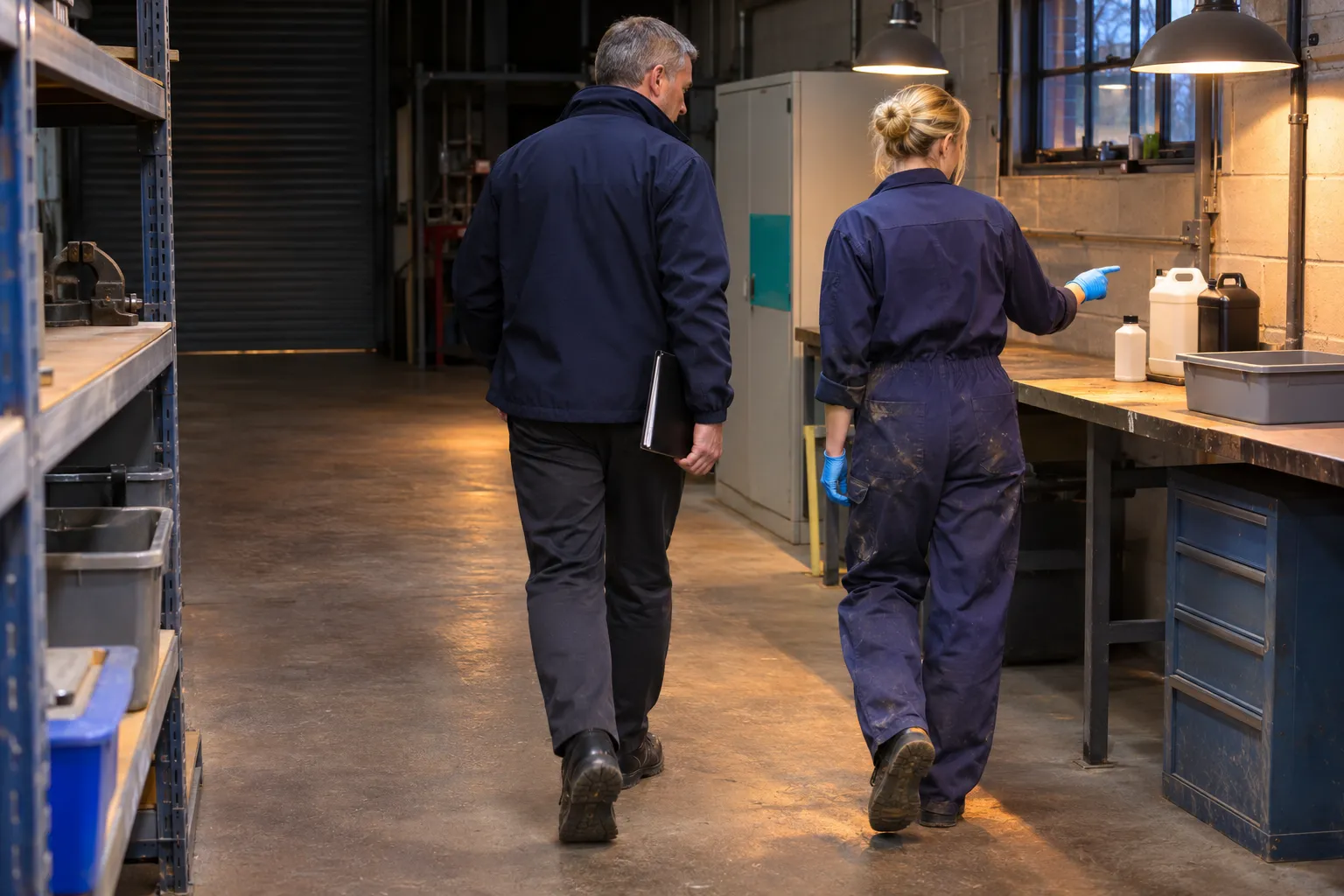
Knowing how to carry out a COSHH risk assessment starts with a full list of the substances used or generated on site. For each task, describe how it is actually performed, including the equipment, location, quantities and work patterns. The HSE’s guidance on carrying out a COSHH assessment follows the same approach.
- Walk the site with staff: find exposure points and check the precautions already in use.
- Ask direct questions: record any splashes, symptoms, incidents or concerns that workers raise.
- Cover non-routine work: include transfer, decanting, cleaning, maintenance, breakdowns, spillages, waste handling and foreseeable emergencies.
Non-routine work is where assessments most often fall short. A cleaning job or a breakdown repair can create far more exposure than normal production. It needs the same attention you would give it in a broader workplace risk assessment.
Establish who is exposed and how
For each task, start with the operator, then widen the view. Nearby workers, cleaners, maintenance staff, contractors and visitors may all be exposed, often without the protection the operator has.
Next, look at the route of exposure: inhalation, skin and eye contact, absorption through the skin, swallowing, or entry through cuts and punctures. Then consider the level, frequency and duration. Maintenance work often brings the highest exposure, even if it happens only rarely.
Finally, put the substance’s hazardous properties and possible health effects alongside the conditions of use. The quantity, concentration, application method and workplace conditions together decide how much exposure to hazardous substances actually occurs.
Evaluate evidence and decide what must change
Safety data sheets describe a product’s hazards and the precautions it needs. They are not a COSHH assessment, though. They cannot tell you about your actual task, ventilation, quantities, the people exposed or whether your controls work. Check labels, current supplier information, relevant HSE task guidance and whether a workplace exposure limit applies. Exposure must remain below any applicable workplace exposure limit (WEL), but meeting that limit alone does not necessarily demonstrate adequate control. Employers must also apply the principles of good control practice and, for substances capable of causing cancer, asthma or genetic damage, reduce exposure to as low a level as reasonably practicable.
Compare the risks against how well your existing control measures perform, decide what further precautions are needed and name who will put them in place. An action plan is not permission to carry on. Adequate controls must be in place before exposure is permitted.
Putting assessment findings into practice
An assessment only protects people if its findings change how the work is done. That means choosing the right controls, preparing workers and planning for when things go wrong.
Prevent or control exposure
Choose control measures in order. First, avoid the hazardous substance or process where you can. Next, substitute a safer product or method. Then use enclosure, closed transfer or extraction at source before relying on administrative measures.
Ventilation, safe methods and supervision may still need PPE as a further safeguard. Personal protective equipment is a backstop, not the first answer, because it only works if it is used correctly every time.
- Gloves and eye protection: chosen for the specific substance and task, not taken from general stock.
- Respiratory protection: tight-fitting RPE needs a suitable face-fit test for each wearer.
- Storage: labelled containers, with incompatible materials kept apart.
- Transport and waste: safe movement of substances and suitable clean-up for contaminated materials.
These arrangements are part of wider risk management, not something added afterwards. A well-chosen extraction system still fails if contaminated rags are left in an open bin next to it.
Prepare workers and emergency responses
COSHH training, instruction and supervision must fit the tasks employees actually do, including relevant cleaning and maintenance work. Workers need to understand the substance risks, the assessment’s findings, the controls and the emergency procedures. Getting this right is one of the central COSHH employer responsibilities.
Employee responsibilities under COSHH include using extraction and protective equipment as instructed, following hygiene measures and reporting defects promptly. Watching someone do the task shows whether effective health and safety training is being applied in practice. Plan for foreseeable incidents in advance: first aid, spill response, trained and equipped responders, communications and waste. Share relevant hazard information with contractors too.
Managing spills, accidents and emergency incidents
A COSHH risk assessment must consider foreseeable accidents, incidents and emergencies involving hazardous substances. This includes chemical spills, leaks, accidental exposure and uncontrolled releases of fumes or vapours. Employers need procedures proportionate to the risks, rather than relying on staff to decide what to do when an incident occurs.
Spill containment and clean-up: Procedures should explain how to raise the alarm, isolate the affected area, prevent further exposure and contain a spill where it is safe to do so. Suitable spill kits, protective equipment and disposal arrangements must reflect the substances involved. Only trained and appropriately equipped personnel should attempt containment or clean-up. Larger or particularly hazardous incidents may require evacuation and emergency services.
First aid and decontamination: Employees must know how to respond to skin or eye contact, inhalation or accidental ingestion. Appropriate first-aid facilities, emergency eyewash or washing arrangements should be available where the assessment identifies a need. First-aid instructions must reflect the substance involved and its safety data sheet. Anyone seriously affected should receive prompt medical attention, without exposing rescuers to unnecessary danger.
Emergency planning and reporting: Employers should establish clear responsibilities, communication and evacuation arrangements, and ensure employees understand the procedures. Relevant emergency drills should be practised and reviewed where required. Following an incident, the employer should investigate what happened, review the COSHH assessment and confirm that effective controls are restored before work resumes.
Provide health surveillance when required
Health surveillance looks for harmful changes in workers’ health where the COSHH criteria are met. It does not replace exposure controls. It may involve skin checks, symptom questionnaires or an occupational health assessment.
The HSE says exposure to metalworking-fluid mist or fluid calls for health surveillance. Employers must maintain a health record for each employee subject to COSHH health surveillance and retain it for at least 40 years from the date of the last entry. This is separate from confidential medical records, which are held by the occupational health professional and may only be accessed by the employer with the employee’s written consent. Any findings should lead you to review the controls and the risks to other workers.
Recording, checking and reviewing findings
A record matters only if it helps people work safely and shows that controls are checked. Below we cover what to write down, what evidence to keep and when to look again.
Make the record usable on site
A practical record of a COSHH risk assessment names the task and substance, the hazards, exposure routes and people affected. It then sets out existing and additional controls, who owns each action, the deadlines and the emergency arrangements.
- Assessor and date: who made the assessment and when.
- Exposure limit: any relevant WEL for the substance.
- PPE, monitoring and surveillance: what is required, and for whom.
- Effectiveness checks: how and how often you will confirm that controls work.
There is no fixed time allowed to complete one. A generic template becomes useful only once it has been checked against your actual premises, substances, tasks and people. Adding your company name to a worked example does not make it your assessment.
Check controls and retain evidence
Local exhaust ventilation generally needs a thorough examination and test at least every 14 months, with shorter intervals for specified processes. Routine checks during use are still needed. Keep records of these tests and any resulting repairs for at least five years. A practical health and safety checklist can help spot missing controls or defects between formal checks.
Exposure monitoring may be needed to establish or maintain adequate control. It is not automatic for every substance, and it is no substitute for testing extraction. Keep identifiable personal exposure records for at least 40 years. Other monitoring records need keeping for at least five years from the last entry.
Review when conditions or evidence change
Review the assessment regularly, and straight away if the work changes significantly or you have reason to doubt it. There is no universal rule to redo every assessment every 12 months. A failed control test, a monitoring concern, symptoms, a complaint, a spill, an accident or a near miss can each trigger a review of the work affected.
New substances, equipment, output levels, staffing or health information may also mean a revision. Parts that have not changed do not need rewriting. A named person should still confirm that actions were completed and that the work stays controlled. Our guide to a health and safety audit versus a risk assessment explains how audits test whether these reviews actually happen.
Examples across four workplace settings
The same principles apply in every sector, but the exposures differ. These examples show where assessments tend to look too narrowly.
Manufacturing and engineering
In manufacturing, assess powder or liquid charging, transfer, process by-products, cleaning and maintenance, not just the ingredients you buy. Closed transfer, enclosure or extraction may be the right controls. In engineering, treat welding and cutting fume, grinding dust, degreasers, and metalworking-fluid mist and skin contact as separate exposures; sump cleaning may need its own assessment. Engineered-stone cutting, hand finishing, slurry removal and workwear cleaning each create different silica exposures.
Cleaning and hospitality
Cleaning assessments should cover concentrates, dilution, decanting, spraying, wet work, splashes and ventilation. A ready-diluted product or less pouring may reduce exposure.
- Hospitality product range: oven and drain cleaners, sanitisers, bleach, descalers and toilet cleaners.
- Secure storage: labelled and locked away, protecting both staff and guests.
- Incompatible mixtures: bleach-containing products kept apart from acidic cleaners and ammonia.
Mixing bleach with acids or ammonia can release harmful gas. The assessment should therefore set out how these products are kept apart and what the spill response is.
A worked example and further support
Take oven cleaning in a hotel kitchen. The assessment identifies the cleaner and anyone nearby, and checks the product’s hazards using its safety data sheet. It then records the application method, ventilation and suitable protective equipment, along with first aid, spill arrangements and review triggers. This turns product information into instructions people can follow.
Salusphere Global offers a free, no-obligation Health and Safety Audit, with the scope agreed with you. It can identify gaps in how you manage hazardous substances and lead to a targeted COSHH review. It is not a certification, and your legal duties stay with you.
Frequently Asked Questions
What should an employer do if adequate control of a hazardous substance cannot be assured?
Stop the affected activity and keep anyone who is not needed away. Use only trained and suitably equipped responders, fix the defects and review the assessment before the work restarts.
Must employees be told the results of exposure monitoring?
Yes. Employees should be told the results of exposure monitoring. If monitoring shows a workplace exposure limit has been exceeded, tell them or their representatives promptly.
Are there stricter requirements for carcinogens, mutagens and asthmagens?
Yes. Exposure to these substances must be reduced as low as reasonably practicable. Staying below a workplace exposure limit is not enough on its own to show adequate control.