

Table of Contents
- What a workplace mental health policy is and why it matters
- Legal duties every employer has on mental health in the workplace
- What to include in your health and wellbeing policy
- How to implement a mental health and wellbeing policy at work
- Frequently asked questions
This guide explains how a workplace mental health policy can help UK employers set expectations, manage work-related stress, support employees and turn good intentions into practical action.
What a workplace mental health policy is and why it matters
A workplace mental health policy sets out how an organisation will protect mental wellbeing, respond to concerns, and provide consistent mental health support. It gives managers and employees a clear reference point, whether the issue relates to work pressure, relationships, change, or personal circumstances that affect mental health at work.

Defining a health and wellbeing policy for your organisation
A strong health and wellbeing policy should explain your organisation’s approach to prevention, early intervention, and health support. It should link clearly with related policies, including absence management, equality, performance, and bullying and harassment.
It should also reflect reality. People move in and out of different states of mental wellbeing, and poor mental health can affect any employee, including a senior leader or line manager.
Legal duties linked to mental health and work-related stress
Employers have duties to protect health, safety and welfare at work, and this includes managing work-related stress and other risks that may affect mental wellbeing.
For senior leaders, HR teams and managers responsible for people, the starting point is understanding what the law expects and how that should shape your approach to mental health at work. A sound wellbeing policy helps turn legal duty into practical action.
Key legislation governing health at work in the UK
Several laws shape an employer’s responsibilities for health at work. Together, they create the framework for managing risk, preventing discrimination and providing appropriate mental health support for employees.
- Health and Safety at Work etc. Act 1974 sets out general duties to protect employees’ health, safety and welfare. That includes managing work-related stress and other risks to mental wellbeing.
- Management of Health and Safety at Work Regulations 1999 require employers to assess workplace risks, including risks that may affect mental health at work, and to put sensible control measures in place.
- Equality Act 2010 protects workers from discrimination linked to disability, including some mental health conditions where the effects are substantial and long term. It also requires reasonable adjustments where needed.
- Disability Discrimination Act 1995 (Northern Ireland) provides similar protection in Northern Ireland, covering disability discrimination and the duty to make reasonable adjustments.
Health and safety law requires employers to identify and reduce risk. Equality law requires them to avoid discrimination and consider adjustments when a health condition has a significant impact. In practice, both matter when managing mental health in the workplace.
Reasonable adjustments and the risk of discrimination
If an employee is struggling with their mental health, an employer should not jump straight to formal capability action or dismissal. The first question is whether adjustments are needed and whether existing policies and management arrangements are helping or making things worse.
Reasonable adjustments might include flexible hours, changes to workload, clearer priorities, amended targets, quieter workspaces, additional supervision or a phased return after sickness absence. What is reasonable will depend on the role, the organisation and the circumstances.
Where an employer fails to explore sensible adjustments, the risk of discrimination increases. In some cases, that may amount to disability discrimination. This is why line manager capability, HR judgement and a workable wellbeing policy all matter so much.
Risk assessments for mental health at work
Employers are expected to assess risks to health at work, including psychosocial risks that may affect mental wellbeing. A stress risk assessment should be a real management tool, not a paper exercise. It should be reviewed regularly and updated when working conditions, workloads, structures or roles change.
Done properly, this process helps an employer identify pressure points, prioritise action and strengthen mental health support. It also gives useful evidence when reviewing broader policies, absence trends and support arrangements.
Recognising psychosocial risks linked to mental health at work
A useful wellbeing policy should recognise the risks that affect people’s experience of work. Common psychosocial risks include excessive workload, low control, poor support, unclear roles, badly managed change, bullying, harassment, job insecurity and tension between work and home demands.
They sit at the centre of health in the workplace and can quickly affect attendance, performance, culture and retention. They may also increase the likelihood of discrimination complaints if concerns are ignored or handled inconsistently.
Some groups of employees may face higher exposure because of the work they do. Health, emergency and humanitarian settings are obvious examples, but the same principle applies elsewhere. A generic approach is rarely enough. Risk assessment, adjustments and mental health support need to reflect the reality of the job.
What employers should do next
If your organisation has not recently reviewed its approach to mental health at work, now is a sensible time. Start with your risk assessments, policies, manager capability, reporting routes and current wellbeing policy. Then look at whether employees can access practical mental health support early enough.
Salusphere Global helps organisations review workplace risk, strengthen policies, improve mental health at work arrangements and identify proportionate next steps through audits, workplace wellbeing needs assessments, competent person support and training.
If you want a clearer picture of where your organisation stands, speak to Salusphere Global about a health and safety audit or a workplace wellbeing review.
What to include in your health and wellbeing policy
A policy hidden on the intranet and rarely used will not improve workplace mental health. For a policy to matter, people need to understand it, trust it and know how to use it. This guide sets out what a practical workplace mental health policy should include, how it connects to health at work, and what employers should think about when turning a document into day-to-day practice.
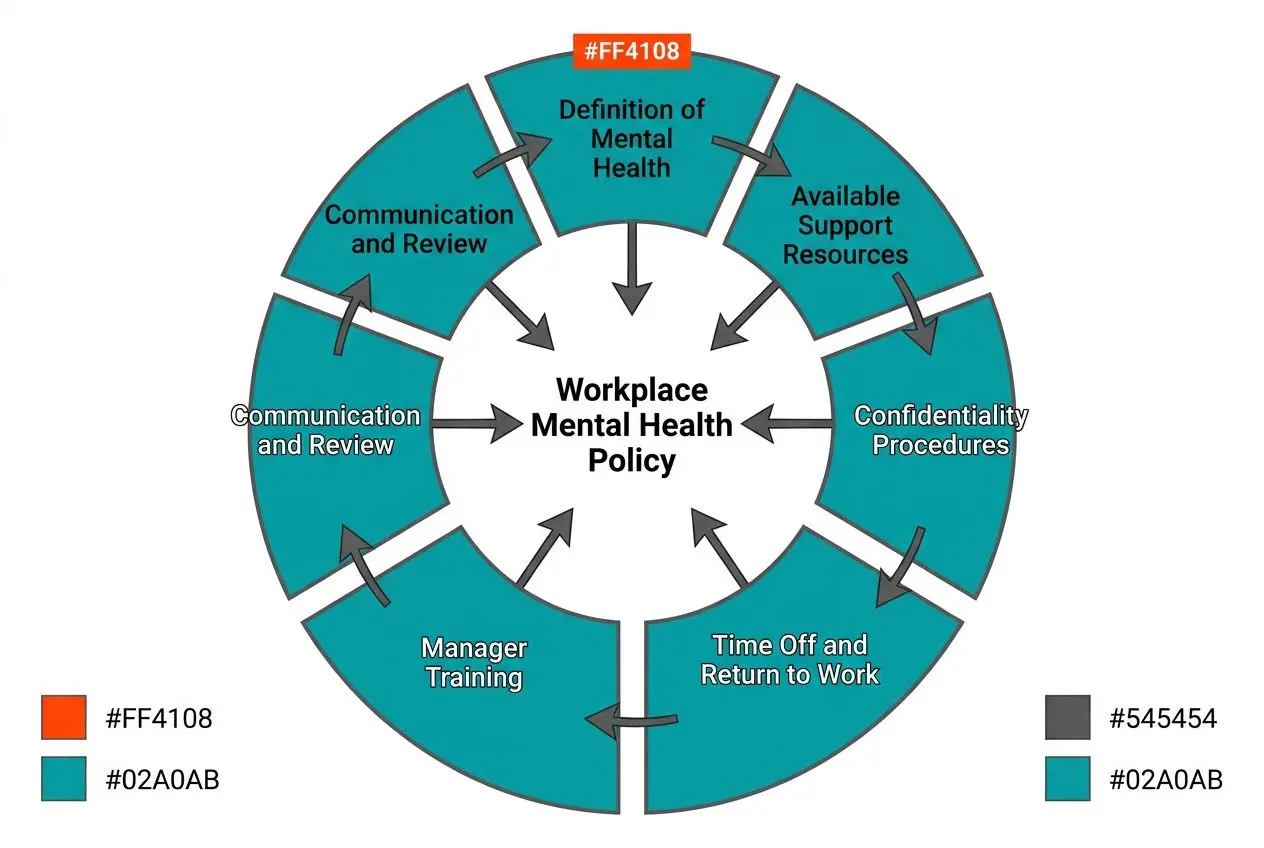
Core components every mental health workplace policy needs
- Definition and scope, explain what the policy covers, who it applies to, and how it links to your wider work policy and existing health and wellbeing policy.
- Support and resources, set out the internal and external resources available, such as Mental Health First Aiders, HR support, occupational health, line manager conversations and employee assistance services, with simple instructions on access.
- Roles and responsibilities, make clear what is expected of a manager, leaders, HR and each employee in supporting health and wellbeing at work.
- Training, outline what training is provided, who receives it, and how often it is refreshed so managers and teams can respond appropriately.
Mental health policy templates can be useful as a starting point, but they should never be copied across without thought. A policy needs to reflect your organisation’s risks, structure, culture and working environment. That is often where gaps appear. A review of your current arrangements, including leadership capability and support systems, can help shape a more realistic document.
Confidentiality, absence and return-to-work procedures
Any health at work policy covering mental health should explain confidentiality in plain terms. People need to know how information will be handled, who may need access to it, and when disclosure may be necessary. If this is vague, employees are far less likely to speak up early.
Your workplace mental health policy should also cover absence, return to work and practical adjustments. That may include phased returns, temporary changes to workload, altered hours, changes to the working environment or regular check-ins with a manager. These steps are important for both recovery and good management practice.
It is also sensible to review absence triggers and related procedures. If they are applied without flexibility, they may disadvantage someone with an ongoing mental health condition and increase the risk of discrimination. A strong health and wellbeing policy should help managers respond consistently while still using judgement.
How to communicate and review your workplace policy
A health at work policy should be introduced properly from day one. Induction matters, but so does reinforcement afterwards. People should be able to find the policy easily, understand what it means in practice and know where to go for help. That is how a wellbeing policy becomes part of everyday management rather than an exercise.
For practical support, the mental health policy guide from ACAS is a helpful reference point when developing or reviewing your health and wellbeing policy.
Set a review point within six to twelve months and schedule subsequent reviews annually or whenever your working model or workforce changes significantly. Involve managers, HR and employees from different parts of the organisation.
As a final check, make sure your workplace mental health policy aligns with related documents, including any existing health and wellbeing policy, absence management procedure and equality policy already in place. Employers often benefit from bringing these together into a clearer framework, supported by training, practical guidance for each manager and proportionate systems for identifying where support or adjustments may be needed.
If you are reviewing your current workplace mental health policy, updating a health at work policy or comparing mental health policy templates, Salusphere Global can help you assess what is already in place, identify gaps and prioritise sensible next steps. That may include a workplace wellbeing needs assessment, manager training or broader support to strengthen your approach to health and wellbeing across the organisation.
Assign responsibility and governance across the employee lifecycle
Accountability needs to be visible. Appoint a senior leader to own the health and wellbeing policy so every employee can see that mental health at work is a leadership issue, not something left solely to HR. That helps set time, budget and attention, and makes it easier to review whether the policy is having any real effect on health at work.
HR or the People team should coordinate the framework, but implementation depends heavily on each manager. Line managers are usually the first to spot changes in behaviour, attendance, performance or relationships at work. They need to know how to respond, when to escalate concerns and how to put reasonable adjustments in place where needed.
Local champions and Mental Health First Aiders can add another layer of support. They help make workplace mental health conversations more approachable, especially in larger organisations, across multiple sites or in remote teams. They are not there to replace clinical support or management responsibility. They are there to guide people towards the right help and keep mental health and wellbeing visible. Mental Health First Aiders should not be expected to act as counsellors, clinicians or a substitute for proper management support.
| Role | Primary responsibility | Key activity |
| Senior leader | Policy ownership and strategic oversight | Championing mental health and wellbeing at leadership level and allocating resources |
| HR / People team | Development, legal alignment and communication | Drafting the wellbeing policy, coordinating training and scheduling reviews |
| Line manager | Day-to-day implementation and support | One-to-ones, absence management, spotting poor mental health and making adjustments |
| Mental Health First Aider | Early support and signposting | Supportive conversations and directing people to appropriate resources |
| Local champion | Visibility and feedback across teams | Promoting the policy, gathering feedback and reinforcing healthy working practices |
Train every manager to respond well
Training is one of the clearest gaps in many organisations. A manager cannot support mental health in the workplace confidently if they have never been shown how. They need practical skills: how to start a conversation, how to listen without overstepping, what signs of poor mental health may look like and what action is reasonable in their role.
A health and wellbeing policy may say the right things, but if managers are uncertain, inconsistent or worried about saying the wrong thing, support becomes patchy. That creates risk for the organisation and a poor experience for the employee.
Useful training should cover mental health and wellbeing, absence, confidentiality, boundaries, referral routes and workplace adjustments. It should also help managers understand that support is not just about crisis response. It is about early conversations, sensible workload management and creating conditions that protect health at work.
Salusphere Global provides mental health first aid training for employees and managers who need the confidence to recognise concerns early, hold supportive conversations and signpost colleagues to the right help. This can strengthen your wider approach to workplace mental health and give people practical resources they can use after the course.
Embed mental health at work through communication and systems
If you want a health and wellbeing policy to stick, people need regular reminders, clear routes to support and simple access to training and guidance. Short awareness sessions, manager briefings, employee surveys and visible signposting can all help keep mental health at work on the agenda without creating noise.
Systems matter too. A central platform makes it easier to manage training records, share resources and monitor completion. A workplace training LMS can help organisations organise learning, automate enrolments and maintain audit-ready records across mental health and wellbeing, compliance and wider health in the workplace activity.
Key takeaways for employers
A strong health and wellbeing policy should:
- have a named senior owner and clear governance
- define the role of each manager in supporting mental health at work
- set out how adjustments will be considered and applied
- give every employee access to clear support routes and resources
- include training that improves confidence around workplace mental health
- link mental health and wellbeing with wider health and safety and workplace responsibilities
- be reviewed regularly to check whether it is working in practice
If you want to strengthen your approach to workplace mental health, review your current wellbeing policy, improve manager capability or build a more practical health and wellbeing policy framework, Salusphere Global can help you identify gaps, prioritise action and put the right support in place.
Frequently asked questions
What should a good mental health policy include?
A good mental health policy should set out what workplace mental health and mental wellbeing mean in practice, recognising that mental health at work affects people differently. It should explain what mental health support is available, how an employee can access it, how confidentiality will be handled, and how absence, adjustments and return-to-work conversations will be managed. It should also clarify the role of each manager, what training is provided, and when the policy will be reviewed.
The document should be written in plain English, easy to find, and introduced from day one as part of induction. Reviewing your current policies, checking any existing mental health policy against real working conditions, and using reliable external resources can make the difference between a paper exercise and a useful health policy. The workplace mental health policy guidance from ACAS is a sensible reference point.
Are employers legally required to have a mental health policy?
There is no single law that says every employer must have a standalone employee mental health policy. Even so, the legal duty to protect health at work, including psychological health, is clear. Duties under the Health and Safety at Work Act 1974, the Management of Health and Safety at Work Regulations 1999, and the Equality Act 2010 all apply. That includes assessing risk, addressing discrimination, and taking reasonable steps to support wellbeing and safe health in the workplace.
Salusphere Global can help employers review or develop a workplace mental health policy that reflects their risks, people and operations. See mental health policy support for a practical approach that helps identify gaps, prioritise action and reduce risk.
How do I implement an existing mental health policy effectively?
Implementing an existing mental health policy takes more than sending it round by email. Start with clear ownership. A senior lead should be accountable, and every manager should understand what the policy expects of them. Build it into induction, line management practice and day-to-day decision-making, not just HR paperwork.
Use a mix of communication methods so the message reaches different teams and working patterns. That may include briefings, online resources, manager training and regular reminders. A review of your current environment, risk factors and support arrangements will show whether your mental health policies match what people actually experience.
Effective implementation also means checking whether the workplace mental health approach is working. Track training, review absence and return-to-work trends, and listen to employee feedback. If your organisation wants to strengthen its approach to workplace mental health, speak to Salusphere Global about a workplace wellbeing needs assessment or fractional support.