Table of Contents
DSEAR risk assessments help UK employers deal with fire and explosion risks from dangerous substances, and the law expects them to be specific to real work. This guide explains when an assessment is needed, what it must cover, when zoning and ATEX equipment come into play and how DSEAR fits with COSHH and fire safety. It also explains how to meet your duties in a proportionate way.
When does DSEAR require a risk assessment?
DSEAR applies when you have a dangerous substance at work, not when you pass a set quantity. The questions are whether the substance could create a safety risk and what you have done about it.
The legal trigger
Under the DSEAR Regulations 2002, an employer must make a suitable and sufficient risk assessment where a dangerous substance is present, or is liable to be present, at work and creates a safety risk. DSEAR requirements cover risks to safety from fire, explosion and similar energetic events, as well as risks arising from gases under pressure and substances corrosive to metals.
- Substance and quantity: what the material is, what its properties are and how much is on site.
- Use and storage: how the substance is handled, processed and kept.
- Releases and ventilation: whether vapour, gas or dust could escape and build up.
- Ignition and harm: what could ignite a release and who could be hurt.
A flammable label or a small quantity does not settle the question on its own. A few litres of solvent used near a hot surface may need more attention than a larger, sealed stock in a well-ventilated store.
What employers must do
Regulation 5 requires the assessment, and any measures it identifies, to be in place before a new activity involving a dangerous substance starts. Regulation 6 then requires you to eliminate or reduce the risks so far as is reasonably practicable. Employers with five or more employees must record the significant findings. Smaller employers still have to carry out the assessment.
Other duties and territorial scope
Regulations 8 to 11 add further duties. They cover emergency arrangements, information and training for employees, and identifying relevant containers and pipes. They also require coordination between employers who share a workplace where an explosive atmosphere may occur. The HSE guidance on DSEAR sets out these duties in practical terms.
DSEAR applies across Great Britain. Northern Ireland has its own corresponding legislation on dangerous substances, so don’t assume that Great Britain guidance applies there unchanged.
Which substances and workplaces are affected?
Many organisations underestimate how far DSEAR reaches. It covers both the substances you buy in and the ones your processes create, wherever they are used, moved or stored.
Substances that create safety risks
The relevant substance properties include flammability, reactivity and pressure. In practice, this covers flammable liquids and flammable gases, vapours, mists, flammable aerosols, oxidisers, combustible dust, unstable substances and substances corrosive to metals.
The way a substance is used can change its risk. If you heat a liquid or turn it into a mist, the fire or explosion risk can increase, even when the liquid’s flashpoint is relatively high. Flashpoint is the lowest temperature at which a liquid gives off enough vapour to ignite.
Your assessment must also cover intermediates, by-products, waste, residues and naturally occurring gases. Wood dust from sanding never arrives in a labelled container, but it can still be a significant hazard. The DSEAR responsibilities that apply to employers include materials generated by the work.
Activities beyond the storage room
In manufacturing and engineering, typical examples include paint spraying, solvent cleaning, fuel dispensing, welding with flammable gases, chemical processing, and dust-producing work in woodworking or food production. In warehousing, a good assessment follows substances from unloading through movement, storage, spill handling and waste to dispatch. HSE’s chemical warehousing guidance also recommends a separate, well-ventilated fork-lift charging bay, because charging can generate hydrogen.
The people you consider should go beyond your own employees. Include contractors, visitors and anyone else affected by the work, including neighbouring occupiers or members of the public.
Practical workroom storage precautions
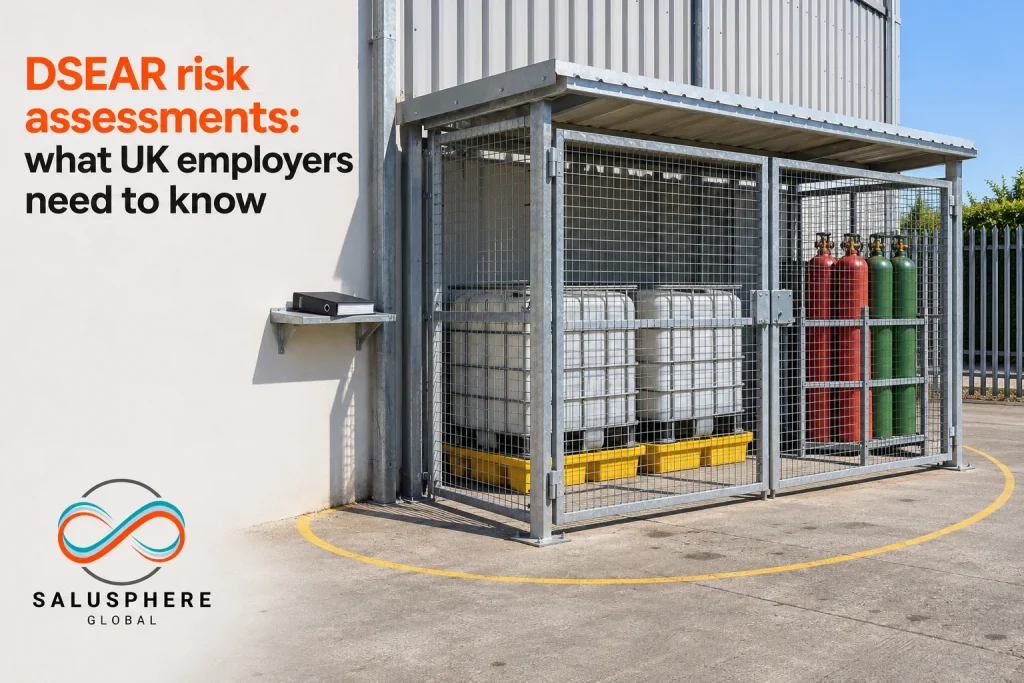
HSE recommends that you keep only the working quantity of flammable liquid in a workroom and keep containers shut. Store the rest of your stock in a suitable dedicated location, away from escape routes, heat and ignition sources.
HSE guidance recommends that flammable liquids kept in workrooms are stored in suitable fire-resisting cabinets or bins, designed to contain spills of at least 110% of the capacity of the largest vessel normally stored inside.
HSE’s recommended maximum for a workroom cabinet or bin is 50 litres for extremely or highly flammable liquids and for liquids with a flashpoint below the room’s maximum ambient temperature. For other flammable liquids with a flashpoint up to 60°C, the recommended maximum is 250 litres. These are guidance values. They are not statutory exemptions from assessment.
How to carry out a DSEAR assessment
A sound assessment follows a clear sequence. You define the work, identify the hazards, evaluate releases and their consequences, and put controls in place. You then keep the assessment current as the work changes.
Define the work and identify hazards
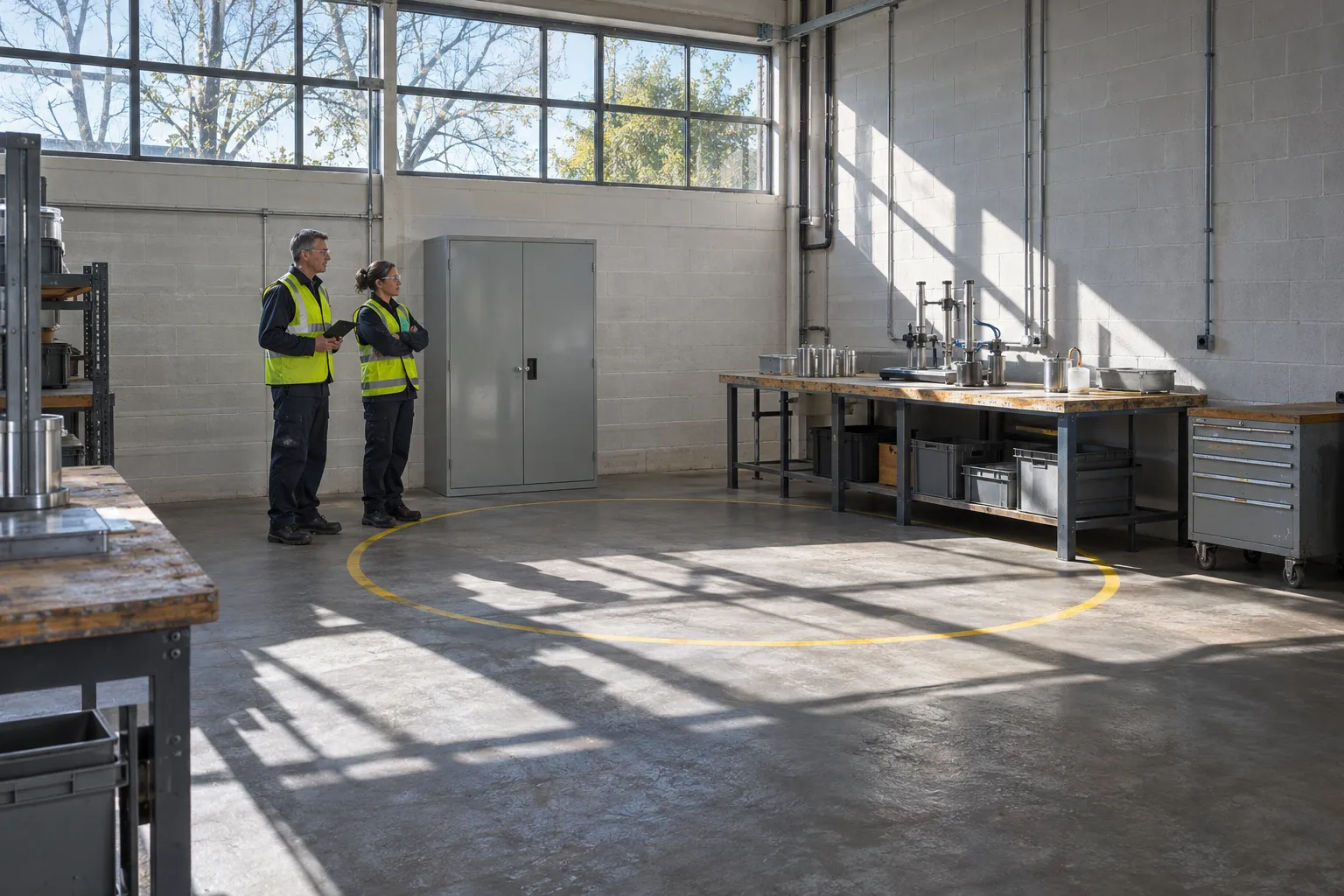
A DSEAR risk assessment starts by setting out the activities, locations and people at risk. It should cover routine work, deliveries, filling, cleaning, breakdowns, maintenance, hot work and foreseeable abnormal conditions. A dangerous substances risk assessment should also include connected places, such as adjoining rooms, ducts and drains, where a release or its effects could travel.
- Safety data sheets: use them to establish hazardous properties, but they don’t describe your actual process.
- Further evidence: process-generated dust or an unusual mixture may need testing.
- Electrical ignition: check for electrical faults, portable equipment and static electricity.
- Other ignition: check for flames, hot work, hot surfaces, vehicles, and non-electrical machinery such as pumps and fans.
Identifying potential ignition sources works best when you watch the real tasks and talk to the people who do them. Salusphere Global recommends this approach because a review of documents alone can miss risks, especially in non-routine work.
Evaluate releases and consequences
Identify the releases that could happen in normal work and through foreseeable failures. Examples include open transfers, vents, leaks, spills, failed seals, overfilling, spraying and filter changes. Release quantity, rate, temperature, pressure, confinement and ventilation all affect whether a hazardous atmosphere builds up or lingers. Settled dust deposits can also become airborne.
The evidence you need depends on the substance. For a liquid, that may be flashpoint and volatility. For a gas, it may be flammable limits and pressure. For a dust, it may be particle size, moisture and ignition characteristics. Explosion-protection design may need test data from representative process dust. Assess the credible consequences for people, escape, equipment and connected spaces, then test whether your existing controls actually work.
Implement controls, review and seek support
Start by asking whether you can remove or substitute the substance or process. If not, limit quantities, prevent releases, capture them at source, provide suitable ventilation and avoid ignition or unsafe conditions. Where prevention cannot remove the danger, use proportionate measures to limit the consequences. These include separation, fewer people exposed, suitable explosion protection and emergency arrangements.
Record your assumptions, significant findings and actions, with a named owner for each action and checks that the safeguards are working. Regulation 5 requires employers to review their DSEAR risk assessment regularly to keep it up to date. A review is also necessary where there is reason to suspect the assessment is no longer valid, following significant changes to the workplace, substances or processes, or where an incident or near miss indicates that existing controls may be inadequate. There is no universal statutory expiry date. Health and safety audits can confirm whether actions have actually been completed.
You can use a competent person from within your organisation or bring in specialist support, but legal responsibility stays with you as the employer. For DSEAR compliance in the UK, Salusphere Global offers assessment support through Tim Hassall, Head of Risk & Compliance. This sits alongside our wider health and safety compliance support, including risk management, training and practical implementation support. We also offer a free, no-obligation health and safety audit. Its scope is agreed with you, and it is not a certification or a substitute for the assessment.
When are hazardous-area zones and ATEX equipment needed?
Zoning is often misunderstood. Some sites zone everything as a precaution, and others assume they never need it. Both approaches skip the analysis that DSEAR expects.
Deciding whether to classify an area
Hazardous area classification identifies places where an explosive atmosphere may occur in quantities that need special precautions against ignition. It is one part of a DSEAR assessment, not another name for the whole thing.
Having a dangerous substance on site does not automatically mean you need zones. Release conditions, ventilation, confinement and consequences decide whether classification is needed. A small, well-controlled activity may need only spill, vapour and ignition controls.
Where zoning is needed, record the release sources, the likelihood of release, your ventilation and dispersion assumptions, and the resulting zone and its extent. An area-classification drawing shows these locations. HSE explains the link between hazardous area classification and ATEX equipment in more detail.
What the zone numbers mean
Zone numbers describe how often an explosive atmosphere is present and how long it lasts. They do not describe how severe an explosion would be, and they do not correspond to a fixed number of hours per year. Combustible-dust zones use the same distinctions as the zones for gases, vapours and mists.
The definitions of hazardous areas and explosive atmospheres also give the usual starting point for equipment categories, shown below.
| Gas, vapour or mist zone | Dust zone | Explosive atmosphere | Usual equipment category |
| Zone 0 | Zone 20 | Present continuously, for long periods or frequently | Category 1 |
| Zone 1 | Zone 21 | Likely to occur occasionally in normal operation | Category 2 |
| Zone 2 | Zone 22 | Unlikely in normal operation and short-lived if it occurs | Category 3 |
Selecting and checking equipment
Electrical and mechanical equipment must suit the specific gas or dust, the temperature limits and the conditions of use. A CE or UKCA mark alone does not show that equipment is suitable for a particular zone. Before a workplace containing classified hazardous areas is used for the first time, Regulation 7(4) of DSEAR requires its overall explosion safety to be verified by a person competent in explosion protection through appropriate experience, professional training or both. Great Britain’s product rules recognise both CE and UKCA routes, and recognition of CE-marked equipment was extended indefinitely from 1 October 2024.
HSE’s DSEAR Approved Code of Practice L138 is practical guidance rather than legislation. Relevant technical routes include BS EN IEC 60079-10-1:2021 for gas-area classification and BS EN 60079-10-2:2015 for dust-area classification. For Ex electrical work, BS EN IEC 60079-14:2024 covers installation and BS EN IEC 60079-17:2024 covers inspection and maintenance.
How does DSEAR fit with other assessments?
A single substance can fall under several sets of regulations. Knowing where each assessment begins and ends helps you avoid both duplication and gaps.
DSEAR and COSHH address different harms
COSHH addresses risks to health from exposure to hazardous substances, while DSEAR addresses risks to safety arising from dangerous substances, including fire, explosion, gases under pressure and substances corrosive to metals.
A solvent can harm the people who breathe it and can also ignite, so it may need both assessments. Our guide to COSHH risk assessment requirements covers the health side in detail.
- Paint spraying: covers both inhalation of mist and flammable vapour in the booth.
- Solvent storage: covers both exposure during decanting and the release of ignitable vapour.
- Dust-generating processes: covers both respiratory harm and dust explosions in extraction.
- Welding gases: covers both fume exposure and leaks of flammable gas.
HSE’s COSHH Approved Code of Practice allows a combined assessment, provided it remains suitable and sufficient for both sets of duties. Answer the health questions and the fire or explosion questions separately within it. Don’t treat DSEAR as just another COSHH assessment.
DSEAR and general fire precautions
A general fire risk assessment covers the whole premises, including detection, warning, escape and evacuation. A DSEAR assessment looks specifically at risks from dangerous substances. One does not automatically satisfy the other.
In England and Wales, the Regulatory Reform (Fire Safety) Order 2005 governs the general fire risk assessment duty. Scotland and Northern Ireland have different fire safety legislation. We cover these premises-wide duties in our guide to workplace fire safety compliance.
Avoiding gaps between assessments
Your general workplace risk assessments set out who may be harmed and which controls are needed. Specialist risks from dangerous substances still need a focused look at real tasks and conditions.
An audit can also check whether your assessments are current, but it does not replace the underlying assessments.
Frequently Asked Questions
Who can carry out a DSEAR risk assessment?
A competent person from within your organisation or a specialist can carry it out, but legal responsibility stays with you as the employer. No particular consultant, professional membership or named DSEAR qualification is universally required. Competence should match the hazards and the complexity of the process. Complex releases, dust testing, zoning, explosion protection or Ex electrical work may need specialist engineering knowledge.
What are the most common DSEAR assessment mistakes?
Common mistakes include treating a safety data sheet as the whole assessment and overlooking cleaning or maintenance. Others are assuming every flammable store must be zoned, or that none needs zoning without examining releases and ventilation. Employers also buy equipment by zone number alone, confuse HSE guidance values with legal thresholds, and leave recommendations unimplemented before new work starts.
What should an employer do when a leak or safeguard failure occurs?
A leak, an unexpected dust release, or a failed ventilation system or interlock can invalidate your assessment or zone drawing. If the work can no longer be kept safe, stop it and follow your emergency plan. Investigate the cause, repair and test the safeguards, and reassess before restarting. Under RIDDOR, certain dangerous occurrences must be reported, including an unintentional fire or explosion that stops plant or suspends normal work for more than 24 hours. Other incidents may also be reportable depending on their circumstances, including specified injuries or dangerous releases. Not every minor spill is reportable.